From unearthing forgotten female travel writers to seeing the Algarve through the eyes of a feral cat, you remind us of the beauty of paying attention. Thank you, Sue, for sitting down with us for a good old chat.
On Unlocking Stories in Travel Writing
Question: In your travel writing retreats, you talk about giving writers ‘permission to be slow’ so that stubborn, creative sentences can arrive. Did you write before moving to Portugal, and how has living in the eastern Algarve shaped your own pace and perspective as a writer?
Sue
I’ve been writing since I was a child. My English teacher’s early encouragement has stayed with me. I worked in international development, where writing reports and policy statements was part of the job, before training as a journalist. My writing now is very different, as I have the freedom to create poems or tell stories. Over the years I’ve also written articles for environmental magazines, interviewed people doing good things in the world, and kept a blog for twenty years about life in Portugal, what I’m growing, local festivals and travel.
Living on a hill in the Algarve, among olive and carob trees and a young food forest, has made me slow down. The workshops and the travel writing retreats are really just an opportunity and permission to let myself become filled up and to share experience. Writer friends visit and often arrive fraught, with phones at the ready. By day three, they are beginning to watch light move across the hills instead. By the end of the week, they are reading books and beginning to imagine stories and even getting them down on paper.
On Women Across Centuries
Q: You also run a podcast series on female travel writers, exploring protagonists who travelled alone across centuries, when society offered them little freedom to do either. What is the most surprising or compelling common thread you have discovered among these women?
Sue
I co-host a women’s travel writing series, and the common thread so far that surprised me is that none of the women we feature set out to be travel writers:
• Lady Mary Wortley Montagu was accompanying her ambassador husband when she travelled to Constantinople.
• Mary Wollstonecraft was chasing stolen silver on behalf of a man who didn’t love her.
• Flora Tristan was trying to acquire an inheritance that was rightfully hers.
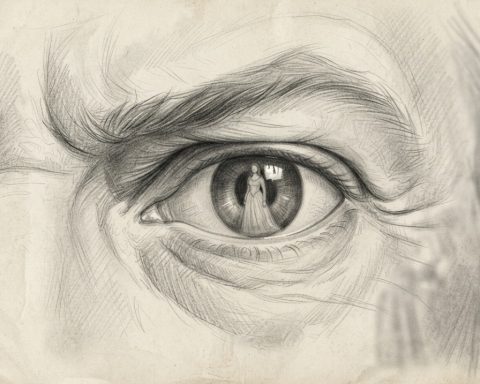
Their writing came out of letters and experiences, as a way of making sense of danger, heartbreak, or rejection. Their outward journeys became the conduit for inward reflection. I try to do this in my own work. Flora Tristan’s account of the women of Lima has stayed with me. In one memorable passage, Tristan describes Lima women dressed in the saya y manto. The saya was a long, close-fitting silk skirt, pleated so tightly it moved with the body, worn in blue, brown, green or black. Over it went the manto, a silk wrap drawn up to cover the head and face entirely, leaving only a single hole for an eye. It’s the kind of detail that reminds me these weren’t just travellers; they were quietly documenting whole worlds that would otherwise have gone unrecorded.
On Documenting Local Traditions
Q: From hand-pollinating dragon fruit on Monte Agudo to documenting the ‘Torch Flower Festival’ in São Brás, your writing captures intimate moments of life in the Algarve. What local custom or tradition in southern Portugal has resonated with you the most?
Sue
Portugal is a country of village and town festivals. Early on the Álvaro de Campos festa became a regular event I attended, as he is a heteronym of the writer Fernando Pessoa and was said to have been born in Tavira. Saint festivals are often hard to keep up with, but what resonates is the dancing, music, and meeting friends from across cultures. For the last few years, the Mediterranean Diet Festival has been a must for the same reasons. Then every year in São Brás is the Torch Festival, where men carry flowers wrapped like a fire torch and walk through the streets shouting “He has risen.”
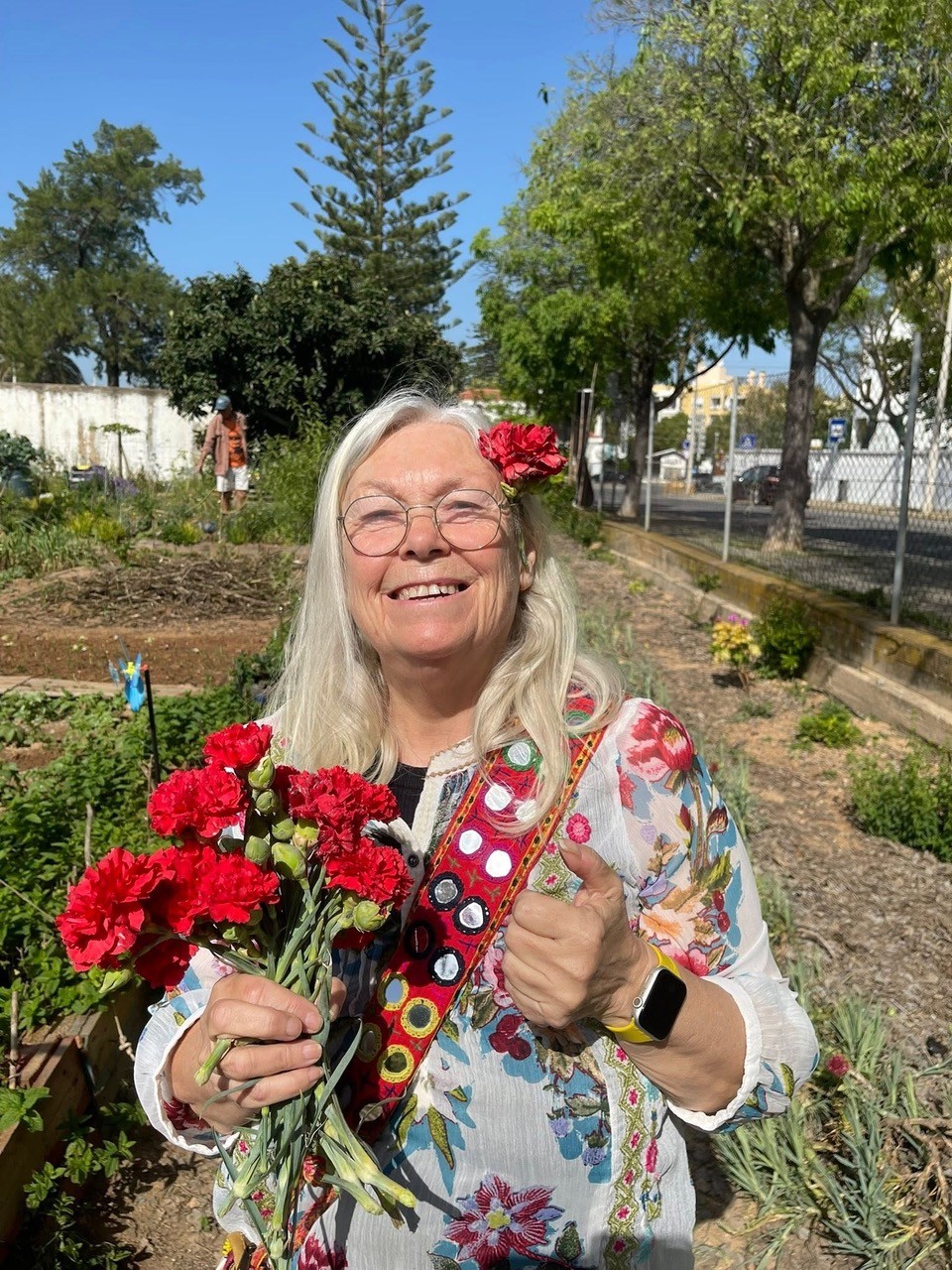
Hand-pollinating dragon fruit isn’t a Portuguese tradition, but it’s something I do each year that has taught me patience. For one, sometimes two, nights the flowers open, and with a torch in one hand and a paintbrush in the other, I knock the pollen onto the brush and coat the stamen. Tending and attentiveness are part of living here. My photo with carnations echoes Tavira’s own link to 25 April 1974, the Carnation Revolution. Many of the flowers for the revolution were grown at the town’s agricultural station, and today the community garden grows red carnations again for Freedom Day.
On Animal Perspective & Magical Realism
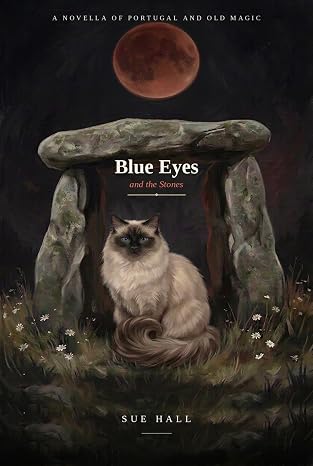
Q: In a couple of days you will launch a new book, Blue Eyes and the Stones. During my research for this conversation, I discovered that it tells a story through the blue eyes of a feral cat. Can you give us more details about the narrative?
Sue
I started writing about her after a feral cat inveigled herself into our lives. I tried to ignore her, but she kept coming back with piercing blue eyes, telling me stories of where she had been and what she needed. She stayed around for fifteen years. As we shared stories with each other, the themes emerged: travel and the interweaving of all life, questioning the superiority of human understanding of what the earth needs. The stories turned into a novel, Blue Eyes and the Stones, which follows a feral cat through southern Portugal’s ancient landscape and stones. Through her eyes we see what matters and what needs tending: water, climate, monoculture, belonging, watchfulness. Magical realism is the genre: Blue Eyes notices, and the reader is free to feel what she feels without a human voice explaining the rights and wrongs.
Advice for Aspiring Writers
Q: For someone sitting down with a blank page who feels overwhelmed by the idea of writing about their journeys or community, what is the single most important piece of advice you can offer to help them get started?
Sue
Just write. By hand, by computer, draw maps of your thoughts, anything that gets it out of your head and onto the page. Trust the smallest idea, words you hear from a tree, a fire, a voice in passing, a smell in a neighbour’s kitchen; don’t look for lessons, explore the meaning of the words or the feelings the language creates. Start there, and let the words come slowly, and on occasion fast. Writing has always been how I let go of the detritus I can’t say aloud, so when the page feels difficult, I remind myself I’m the only one who will see this, and carry on. Then I read it to my husband Jim, just so someone has heard me.
Thank you, Sue.
References:
• Website: www.suehall.net
• Books: Blue Eyes and the Stones: A Novella of Portugal and Old Magic
https://www.amazon.co.uk/stores/Sue-Hall/author/B0HJX26SLG
• Next Travel Writing Retreat: 3-6 May 2027 near Tavira, Portugal.
• Contact: Sue@suehall.net