It is a wonderful thing, the English language, packed with hundreds of handy little idioms designed to soothe the incompetent. ‘It’s not rocket science,’ people love to say whenever you struggle with the basic setting on a toaster or fail to assemble a flat-pack IKEA thing without three leftover screws and a deep sense of existential dread.
As much as I enjoy the old sayings, this time I must respectfully disagree with the anonymous philosopher who coined the phrase.
It is rocket science. Quite literally.
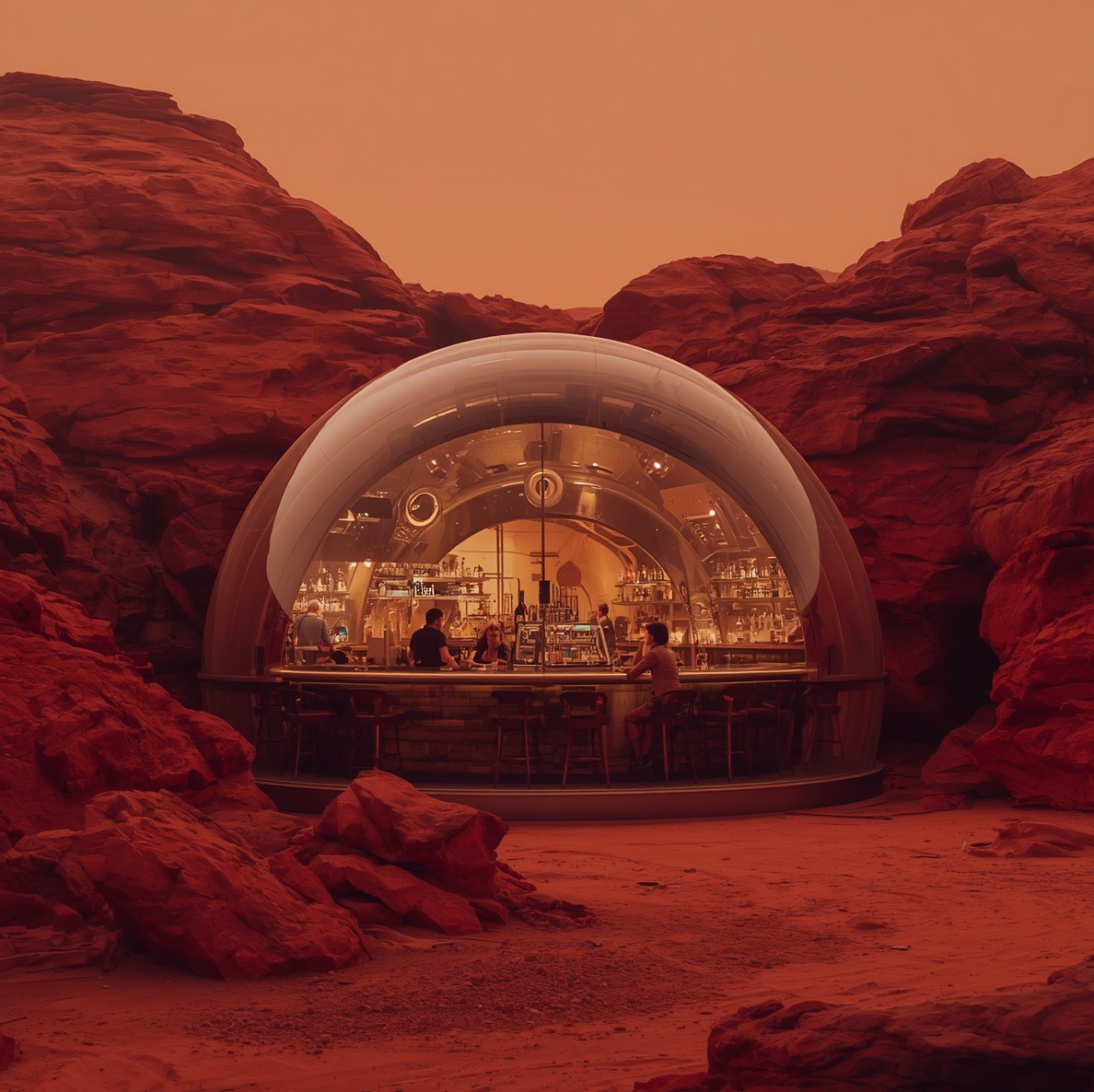
The year is 2126, and I am currently suspended three miles above the rust-coloured dust of Mars, holding a pair of titanium pliers and trying to remember which way to turn an anti-gravitational nut. Below me lies the newly established colony of New Slough-under-Domes, a burgeoning metropolis consisting of sixteen inflatable bio-hemispheres, a dust-recycling facility, and a pub that serves synthesised real ale at sixteen pounds a half-pint.
Back on Earth, when the grand Exodus began, the estate agents promised us a seamless transition to multi-planetary living. ‘A fresh start among the stars!’ the brochures screamed. ‘Simple, intuitive living for the modern pioneers!’ And even worse: ‘Hurry! Be among the first to break ground on a new world.’
What they neglected to mention was that when your plumbing breaks on Earth, you call a bloke named Max who arrives in a van and drinks your tea. When your plumbing breaks in a Martian suburban semi-detached, it requires an advanced understanding of fluid dynamics, orbital mechanics and the precise molecular tension of zero-pressure seals.
Yesterday, my neighbour attempted to fix his automated lawnmower – designed to tidy up the synthetic turf in his pressurised front garden. He turned the wrong dial, accidentally inverted the local gravity field and sent his wife’s prized collection of ceramic gnomes into low orbit.
‘Don’t panic,’ he shouted over the deafening hiss of the airlocks. ‘It’s just a loose lever. It’s not rocket science!’
‘Mate,’ I pointed out, watching a painted gnome (named Doc after one of the seven dwarves from Disney’s Snow White) drift serenely past the double-glazed reinforced window, ‘we are living inside a pressurised tin can attached to a fusion reactor on a dead rock millions of miles from home. Everything here is rocket science.’
Even the most mundane human activities have been overhauled by the sheer absurdity of physics. Cooking breakfast no longer involves merely frying eggs; it involves calculating the thermodynamic displacement of a micro-induction hob in a seven percent oxygen blend so you don’t inadvertently ignite the kitchen ceiling. Making a cup of tea requires a three-stage pressure chamber to stop the water from boiling instantly at room temperature into a useless cloud of scalding vapour.
Humanity thought that moving to the planets would make us an advanced, celestial species. Instead, it has simply turned all of us into deeply stressed, underqualified aerospace engineers.
So, to whoever first declared that a difficult task ‘isn’t rocket science’: come up here and try changing a lightbulb in a secondary oxygen scrubber! Until then, I shall be sitting in my pressurised dome, nursing a lukewarm tea, clutching my instruction manual and begging the universe to give us back our old toasters.