Defying the Clock
In the final year of his life, spanning mid-1972 to his death on 8 April 1973, Pablo Picasso lived in self-imposed seclusion at Notre-Dame-de-Vie, his hilltop villa in Mougins, France. At 91 years old, stripped of the grand social circles that had populated his earlier decades, Picasso engaged in a furious, almost desperate dialogue with his ultimate adversary: mortality.
Rather than yielding to the physical frailties of nonagenarian life, Picasso’s artistic output surged with a frantic energy. His late period was defined by an urgency to paint against time itself. He painted daily, creating hundreds of works: drawings, etchings and canvases marked by raw, gestural brushstrokes, explosive colour and an intentional rejection of polished technique. Critics of the era initially dismissed these late works as the incoherent scribbles of an old man losing his faculties. In reality, Picasso was shedding formal conventions entirely, opting for an unvarnished immediacy that prefigured the Neo-Expressionist movement of the 1980s.
Peering Into the Abyss
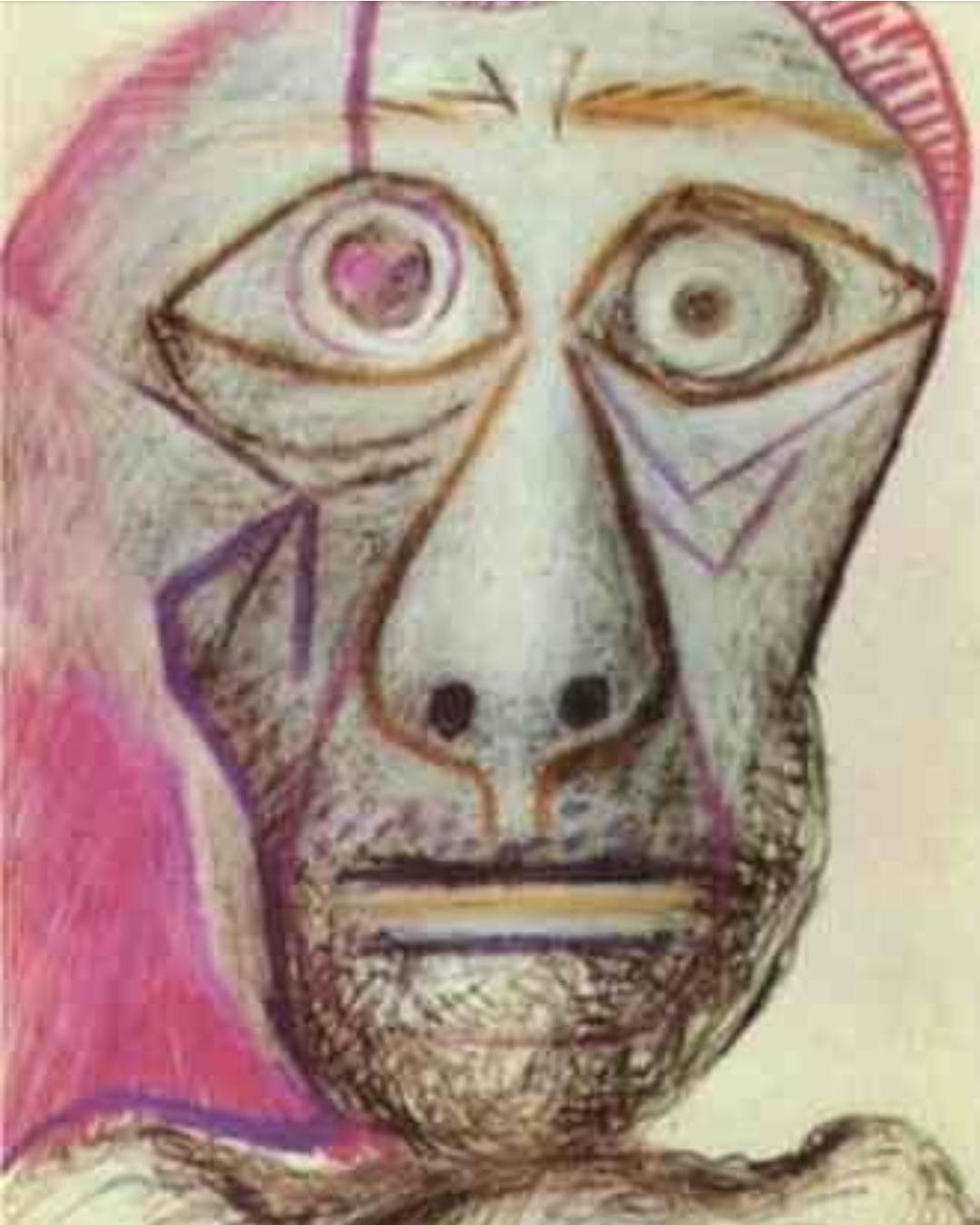
A striking element of his final months was his obsession with self-examination. In June 1972, he created Self-Portrait Facing Death, a self-portrait rendered in crayon on paper. The work features wide, hollow eyes set against a gaunt, green-hued face, capturing a man peering directly into the abyss. It stands as one of the most hauntingly honest self-assessments in art history, a titan of modernism stripping away all bravado to show pure terror and fascination before the unknown.
Masks of Youth and the Engine of Survival
Beyond self-portraits, his late iconography focused heavily on figures of vitality, such as musketeers, matadors, lovers, and mothers with children. These figures served as alter egos through which he projected youth, virility and historical grandiosity, defying the body’s inevitable decay.
Unconditionally supported by his wife, Jacqueline Roque, who fiercely guarded his privacy from the outside world, Picasso worked until his body gave out. On 7 April 1973, he spent the evening working late into the night on a painting of a seated figure. By the following morning, he succumbed to pulmonary oedema and heart failure.
Pablo Picasso’s final year proved that for him, art was not merely a medium of expression, but the literal engine of his survival: a final, defiant assertion of life against death.