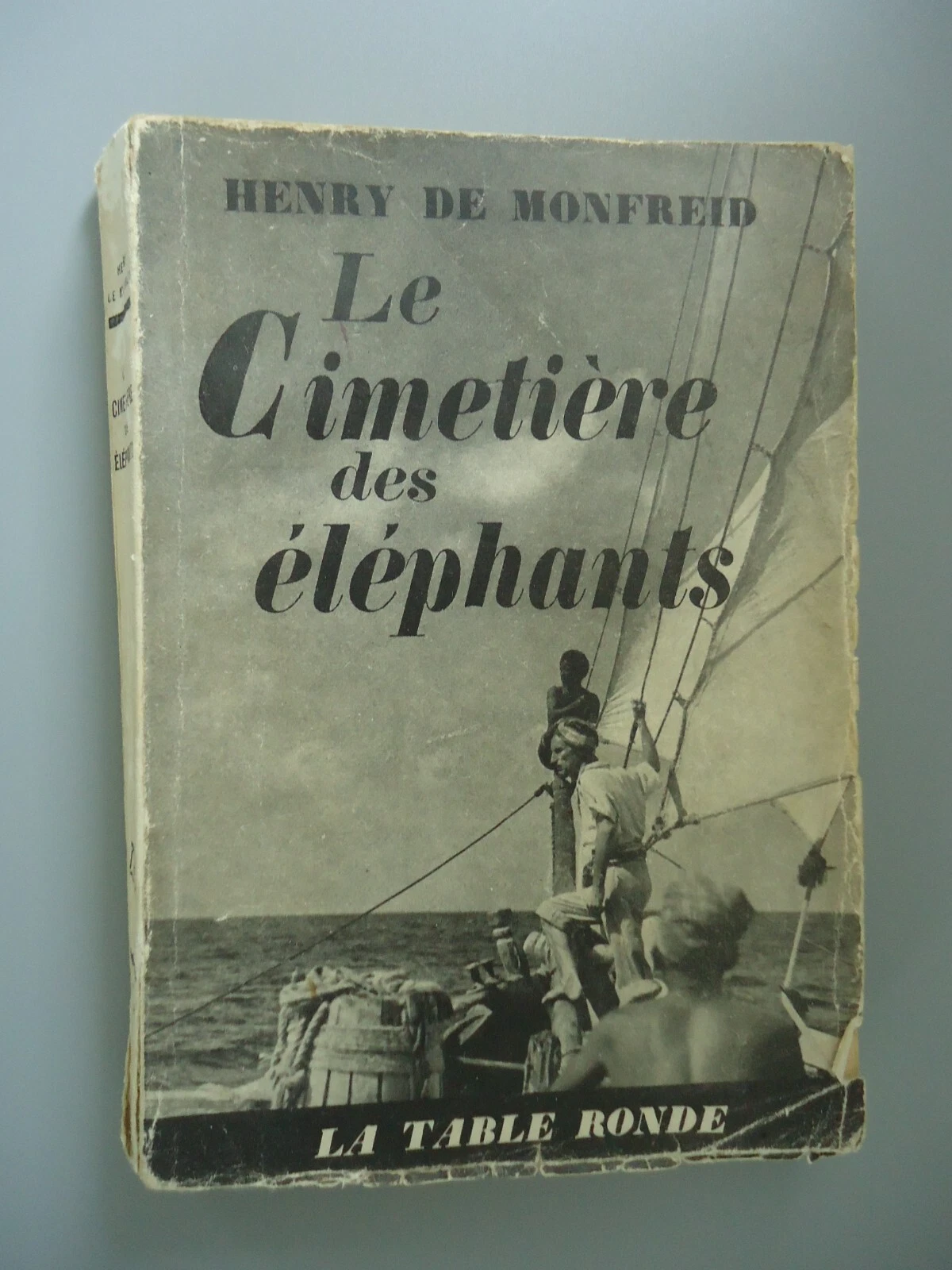
Many years back, almost half a century ago, I read a book that still haunts me today and perhaps explains the strange attraction I feel for the Sunny Continent and its wildlife.
The Elephant Graveyard was written by a man whose very origin was an intriguing paradox. His father, George-Daniel de Monfreid, was born in America before being raised and educated in France. A talented painter and art collector, the elder Monfreid became a central figure in the Parisian avant-garde, famously supporting Paul Gauguin and other master painters of the era. Yet while the father found his obsession on canvas amidst the artistic circles of Europe, the son sought a far ‘wilder’ canvas.
Henry de Monfreid grew up to become one of the twentieth century’s most notorious rogues: an adventurer, prolific writer, Red Sea smuggler and hashish dealer. Disillusioned with mundane French society, he set sail for the Horn of Africa in 1911, adopting local customs, converting to Islam and building his own dhows to run contraband across treacherous waters. His life was a thrilling string of narrow escapes and illicit trades, all recorded in vivid detail across dozens of widely read memoirs.
While he had over seventy books in French, only a handful of his early works were ever translated into English. One primarily has access to: Secrets of the Red Sea or Hashish: A Smuggler’s Tale. Because Le Cimetière des éléphants remains available only in French, any English reviews or discussions rely on the original text or on translations into other languages.
In Le Cimetière des éléphants, Monfreid turns his sharp gaze to the vast landscapes and untamed interior of East Africa. The narrative follows his daring journeys through the bush, capturing the brutal beauty of the terrain and the complex web of tribal life, colonial tension and frontier lawlessness. At the heart of the book lies the haunting myth of the elephant graveyard: the legendary, hidden ground deep in the wilderness where dying pachyderms are said to travel instinctively to draw their final breath, leaving behind immense fortunes in untouched ivory. It remains a mesmerising tale of obsession, wilderness and the enduring magic of Africa.
During the interwar period, French journalism underwent a profound transformation known as l’âge d’or du grand reportage. Led by figures like Albert Londres, Joseph Kessel, Antoine de Saint-Exupéry and rogue literary voices like Henry de Monfreid, this movement laid the structural and stylistic groundwork for modern non-fiction writing.
Their work directly influenced contemporary narrative journalism, immersive non-fiction, travel writing and creative non-fiction in several key ways:
The Journalist as First-Person Protagonist
Before the 1930s, mainstream journalism favoured distant, objective, third-person reporting. Grand reportage shattered this convention by putting the reporter’s subjectivity, physical sensations, and personal risks at the centre of the narrative.
Merging Literary Technique with Investigation
Writers like Kessel and Londres proved that non-fiction could utilise the stylistic toolkits of the novel. They introduced extended dialogue, scene-by-scene construction, character development and even atmospheric sensory descriptions to document real-world events.
‘Colonial Humanism’ and Social Critique
In the mid-1930s, grand reporters increasingly used travel literature not to glorify the imperial institution, but to expose its abuses. Albert Londres’s expose on forced labour (Terre d’ébène) and Kessel’s investigations into slavery in the Red Sea challenged official state narratives. This shift focused mainly on the human impact on local populations rather than imperial ideology.
Pioneering Immersion and ‘Outlaw’ Journalism
Writers like Henry de Monfreid brought a distinct element to 1930s travel prose: total cultural integration and participation in the illegal or underground worlds they wrote about. Rather than visiting as tourists, they lived as sailors, smugglers or desert wanderers. Interesting fact: Monfreid held only French citizenship throughout his life; he never acquired or held nationality in any African state, despite spending decades living, working and travelling across Kenya, Djibouti, Ethiopia, Somalia and the broader Horn of Africa.
The Birth of the Long-Form Formats
In 1930s France, newspapers published massive multi-part serials, as grands reportages, that were later bound into standalone books. This format celebrated the dignity of long-form, slow reporting over quick news cycles.
– – – – –
Ultimately, translating Le Cimetière des éléphants today would remain a vital asset, offering contemporary readers an unfiltered portal into the pioneering roots of immersive journalism and the untamed frontiers of twentieth-century East Africa.