
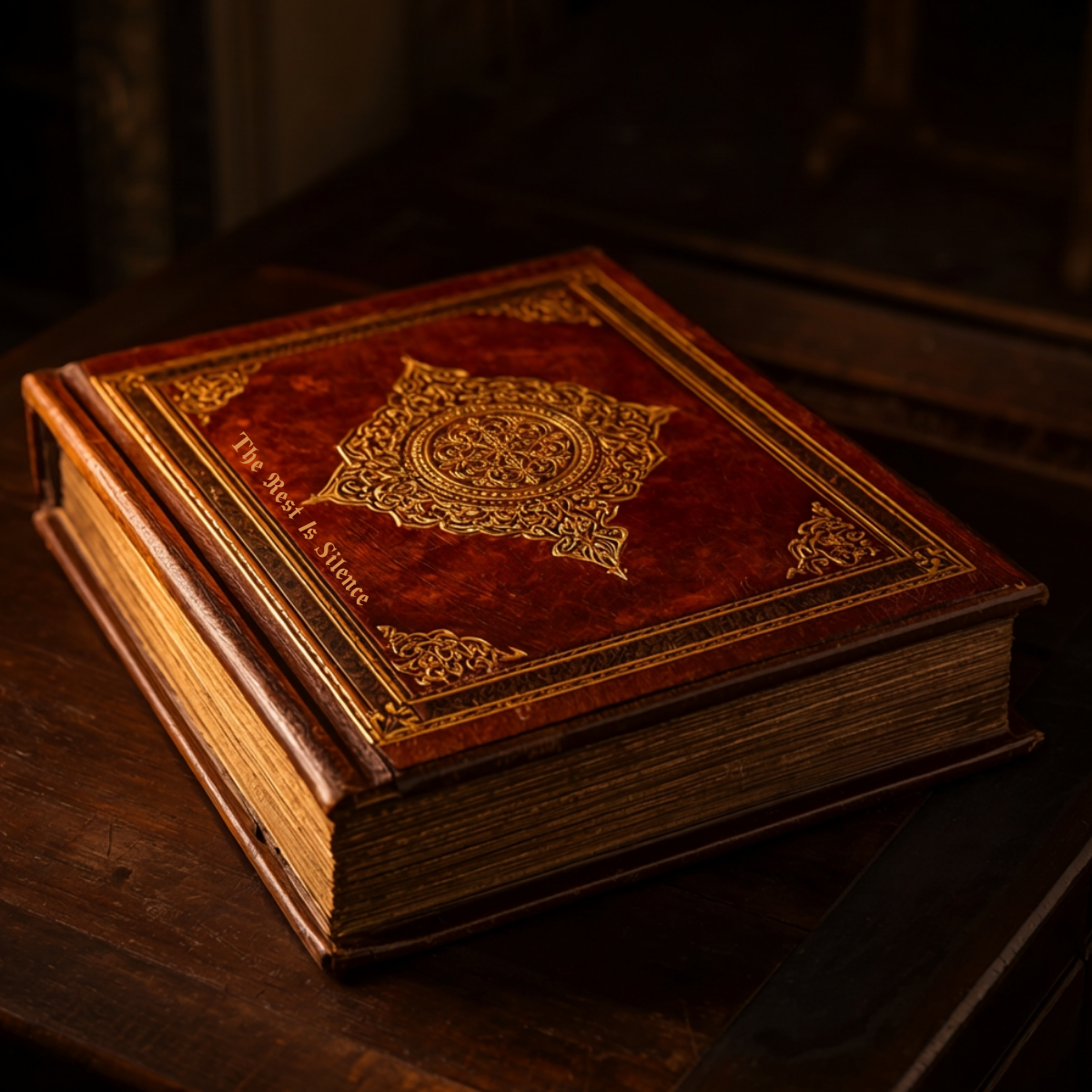
To review a book that contains not a single word feels initially like a nonsensical exercise in literary absurdity. Yet 𝐓𝖍𝖊 𝕽𝖊𝖘𝖙 𝙄𝖘 𝑺𝖎𝖑𝖊𝖓𝖈𝖊, printed in London in the late spring of 1598, is perhaps the most radical artifact in the history of the bound volume. Published exactly one year before William Shakespeare penned Hamlet and forever immortalised our book’s title in the tragic hero’s dying breath, this volume presents a daring philosophical paradox. It is a book of profound, total silence.
The Anatomy of Nothingness
At first inspection, the physical object commands an unmistakable solemnity. Bound in original calfskin with subtle blind tooling along the spine, the Elizabethan construction of the work betrays no hint of satire or cheap gimmickry. The title page displays 𝐓𝖍𝖊 𝕽𝖊𝖘𝖙 𝙄𝖘 𝑺𝖎𝖑𝖊𝖓𝖈𝖊 above a neatly printed publication year of 1598, accompanied by an ornate printer’s mark associated with a small, underground press operating near Fleeteſtreete.
However, turn past the front matter and the reader encounters the book’s singular, astonishing feature. Across three hundred sixteen carefully numbered pages, there is nothing. No ink, no type, no woodcut illustrations, no marginalia. Just empty, unblemished rag paper.
• Page Count: 316 individually numbered pages
• Condition: Exceptional preservation with original deckle edges intact
• Paper Composition: High-grade 16th-century linen rag paper
• Provenance: Recently rediscovered in a private library in Warwickshire
What makes this silence so deafening is the meticulous numbering. The printer did not simply bind a block of blank stationery; each folio was run through a printing press specifically to apply a crisp Roman numeral at the header. The author or printer intended for you to turn every single page, counting the void as you progress through its sequence.
Literary Precursor or Historical Anomaly?
The fascinating question troubling bibliophiles and scholars alike is whether Shakespeare himself encountered this exact volume. Did the Bard hold this heavy, silent tome in his hands, turn its 316 blank pages, and absorb its existential weight before bestowing those famous final words upon Prince Hamlet?
While we cannot say for certain, the textual timeline is undeniable. In 1598, 𝐓𝖍𝖊 𝕽𝖊𝖘𝖙 𝙄𝖘 𝑺𝖎𝖑𝖊𝖓𝖈𝖊 offered an unprecedented conceptual statement. Centuries before John Cage composed 4’33” or Kazimir Malevich painted his Black Square, an Elizabethan printer created a work of pure minimalism that forced the reader to confront the vast expanse of what remains unsaid.
To read 𝐓𝖍𝖊 𝕽𝖊𝖘𝖙 𝙄𝖘 𝑺𝖎𝖑𝖊𝖓𝖈𝖊 is not to absorb the thoughts of another mind, but to be confronted entirely with the echo of one’s own.
A Blockbuster at Sotheby’s: Special Fine Books & Manuscripts Auction of the Year
Lost from public record for nearly four hundred years, the book resurfaced earlier this year in a damp manor house library in Warwickshire, where it had rested undisturbed since the late 16th-century. Now residing safely under high-security glass at Sotheby’s New Bond Street gallery, it comes equipped with ironclad certificates of authenticity verified by carbon dating and paper analysis.
The market anticipation is immense. When a rare copy of Shakespeare’s First Folio fetched $9.98 million (£7.6 million) at Christie’s a few years ago, the literary world gasped. Yet the specialists at Sotheby’s are quietly confident that 𝐓𝖍𝖊 𝕽𝖊𝖘𝖙 𝙄𝖘 𝑺𝖎𝖑𝖊𝖓𝖈𝖊 can easily double that figure when the gavel falls next week.
After all, a First Folio merely contains the words of a genius. 𝐓𝖍𝖊 𝕽𝖊𝖘𝖙 𝙄𝖘 𝑺𝖎𝖑𝖊𝖓𝖈𝖊 holds the ultimate mystery: the vast, breathtaking space where words cease to exist entirely.








Wow that is so interesting and a very wonderful idea. A book full of your own thoughts. What a fabulous thing. Thank you Dan for bringing this into my life. I was unaware of its existence until reading this.