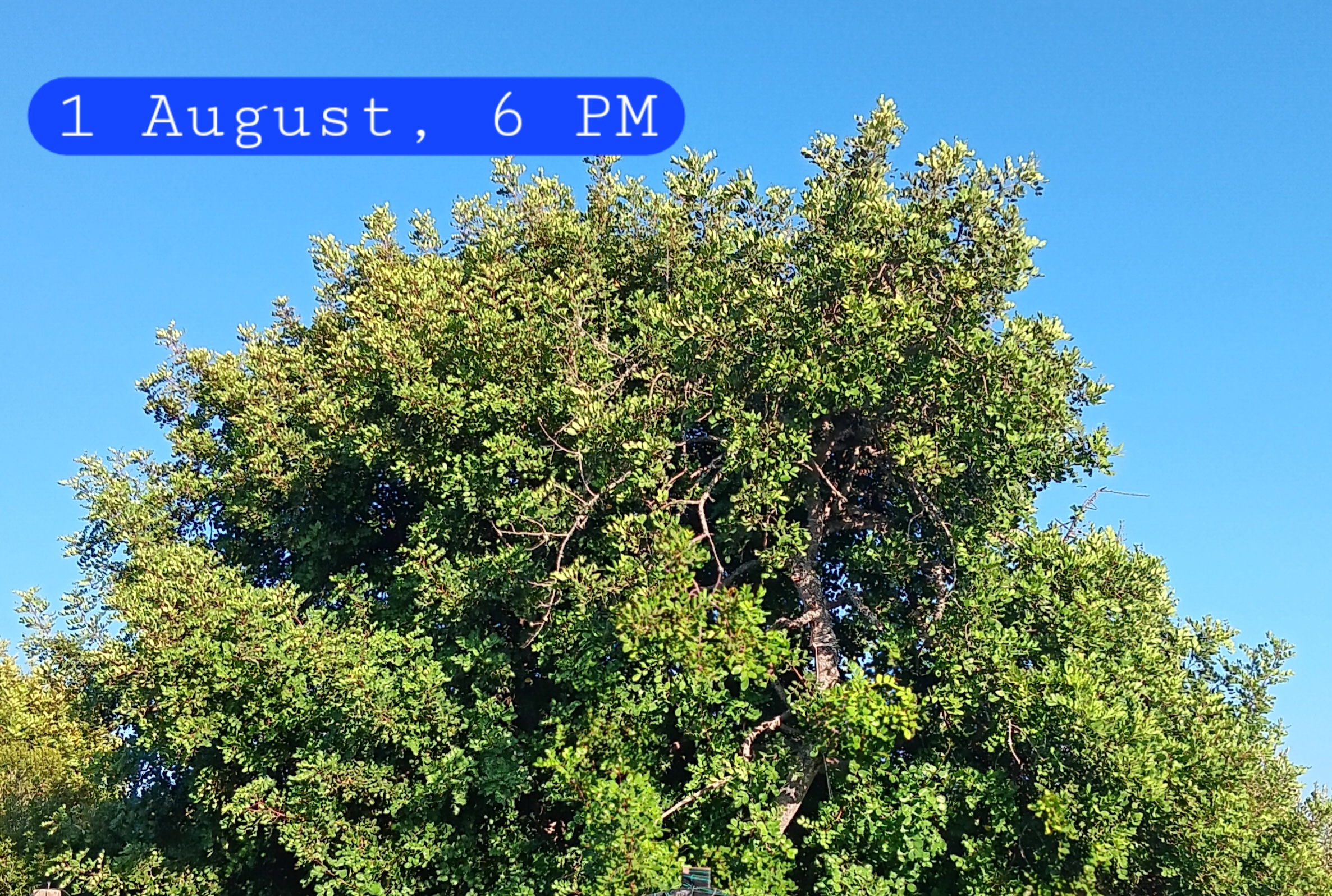
The sky above the twisting carob tree was almost a solid cobalt blue. It was not the soft, changing gradient of a normal evening. Hovering near the apex of the tree, suspended in the impossibly still air, was a floating blue shape. It was a neat, smooth, rounded capsule, as silent as the sky itself. Within its depth, glowing numbers swam with a soft, pulsing light: 1 August, 6 PM. This was not the setting sun. This was a projection, a fixed celestial event. The sky itself had been archived.
She stood in the shadow of the dense, vibrant green foliage, the carob’s leaves casting intricate, skeletal patterns on the red earth. The tree was alive, of course, but it was fixed. It did not rustle in a breeze that did not exist. Its gnarled trunk seemed to hold the weight of thousands of years.
And then, the sound began. Not a gradual crescendo, but a single, deafening wall of vibration. A thousand, a million, August cicadas launched their song simultaneously. It was a visceral, metallic drone that did not just vibrate in her ears but in her teeth, her toenails, the very water in her cells. The air became thick with the sound, a physical pressure.
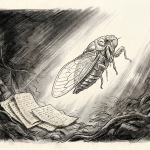
She looked up towards the source, expecting to see a cloud of emerging insects. But she saw nothing. The dense leaves remained motionless. Instead, the cicadas were emerging from the sound itself, from the materialised vibrations. Small, semi-transparent shells of sound spun into existence around invisible forms. They were ghosts of a previous noise, a phantom chorus singing from a time that had already passed. She watched as a shimmering cicada husk, composed of nothing but the resonance, alighted on a low tree branch.
Then, she noticed the ground around the roots. Tiny plastic digital counters were emerging from the soil. One, displaying ‘08:00’, rolled on its side. Another, showing ‘11:00’, cracked open to reveal a pulsing digital heart. They were the shed time-stamps of creatures that had lived entire digital cycles beneath the soil before emerging as this phantom noise.
A large, perfectly transparent cicada landed on her forearm. She felt the scratch like a cool prickle. Looking down, she saw that where it touched her skin, a small digital readout had formed. She brushed it off, but the numbers remained locked: ‘5:59’. She had been archived too.
The entire landscape was a digital ruin. The sun, a fixed idea of 6 PM, refused to set. A digital cicada chorus was an insect simulation of eternity. The tree was a monument to stillness, while a phantom noise was the only motion allowed. She felt the digital stamp on her arm getting cool. The archive was claiming her. The world was being saved, exactly as it was, over and over, until time itself stopped vibrating.