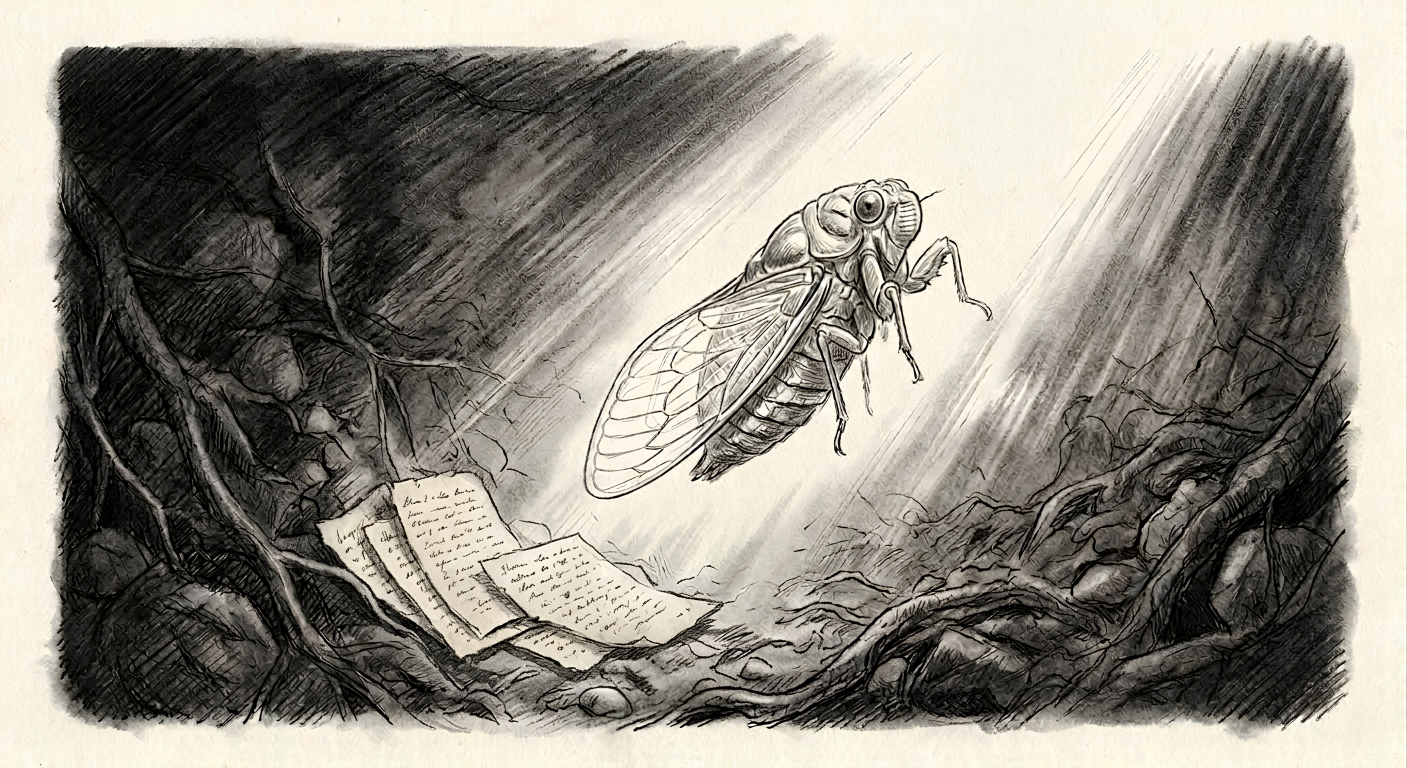
For years, they remain buried. In the dark, quiet loam of obscurity, they labour without a witness, feeding on the subterranean sap of their own imagination. They are the independently published authors of our digital age, artists who write, edit, format, design, and market their own creations. Like the nymph stage of the cicada, their gestation is long, silent, and entirely unseen by the canopy above.
When they finally emerge into the blinding light of the literary marketplace, it is with a desperate, sudden urgency. They shed their shells of privacy and begin to sing. Yet, as their collective chorus rises into the crowded airwaves of the internet, a haunting question echoes beneath the noise:
Why do they sing?
Is it for money? For the vast majority, the financial return of indie publishing is a mirage. In a marketplace flooded with millions of digital titles, where algorithmic gatekeepers demand a relentless toll of advertising just to grant visibility, most independent books sell fewer than a hundred copies. The dream of the breakout bestseller is a lottery ticket purchased with years of unpaid labour. If wealth were the metric, the indie author’s song would be an act of absolute madness.
Is it for fame, then? Or perhaps that more seductive, romantic phantom: posthumous glory? To write with the hope that future generations will excavate your digital manuscript from the ruins of a defunct server is to build a castle on shifting sand. In the hyper-saturated landscape of modern media, where today’s viral sensation is tomorrow’s forgotten data, true fame is a fickle, fleeting spark. The independent author has no traditional publishing house to carve their name into the marble of literary history, no institutional apparatus to ensure their legacy.
No, the truth is far more elemental, far closer to the fragile biology of the cicada itself.
The cicada does not sing to win an audience with the forest at large. Its summer music is an ephemeral, hardwired necessity, a brief, thunderous declaration of existence before its clock runs out. The insect’s adult life lasts but a few weeks; it sings because it must fulfil its purpose in the fleeting moment of sunlight it has been granted.
For the indie author, the struggle is born of this same compulsion. They write because the silence of leaving the story untold is heavier than the sting of being ignored. They hit ‘Publish’ not because they are guaranteed a stadium of listeners, but because the song itself demands to be released into the world. It is an act of radical vulnerability, a refusal to let the inner voice die unuttered in the dark.
There is a tragic beauty in this literary ecosystem. To spend months or years crafting a universe, knowing it may only ever be read by a handful of people, perhaps family, a few loyal friends, and a stranger across an ocean, is a pure, unadulterated form of devotion. It strips away the cynical armour of commercialism and returns art to its ancient, sacred origin: communication for the sake of connection.
The traditional publishing world may look down from its high branches, viewing the independent chorus as a chaotic, unrefined din. But the indie song possesses a wild, untamed liberty that the manicured gardens of traditional publishing rarely afford. Unbeholden to marketing committees, trend forecasts, or corporate gatekeepers, the independent writer sings exactly what they wish, however they wish to sing it.
When summer fades, the cicadas fall silent, leaving behind nothing but fragile, translucent husks clinging to the bark of trees. To the casual observer, their brief season of noise might seem meaningless. But to the forest, their music was the very pulse of life itself.
The independent authors’ books may eventually sink into the quiet depths of the digital archive, like tiny digital shells in a boundless ocean of data. Yet, the defiance of their struggle remains intact. They stood in the sunlight, however briefly, and gave shape to the silence. They sang not for the coin, nor the crown, but because the song lived inside them, and for a beautiful, fleeting moment, the world was forced to listen.