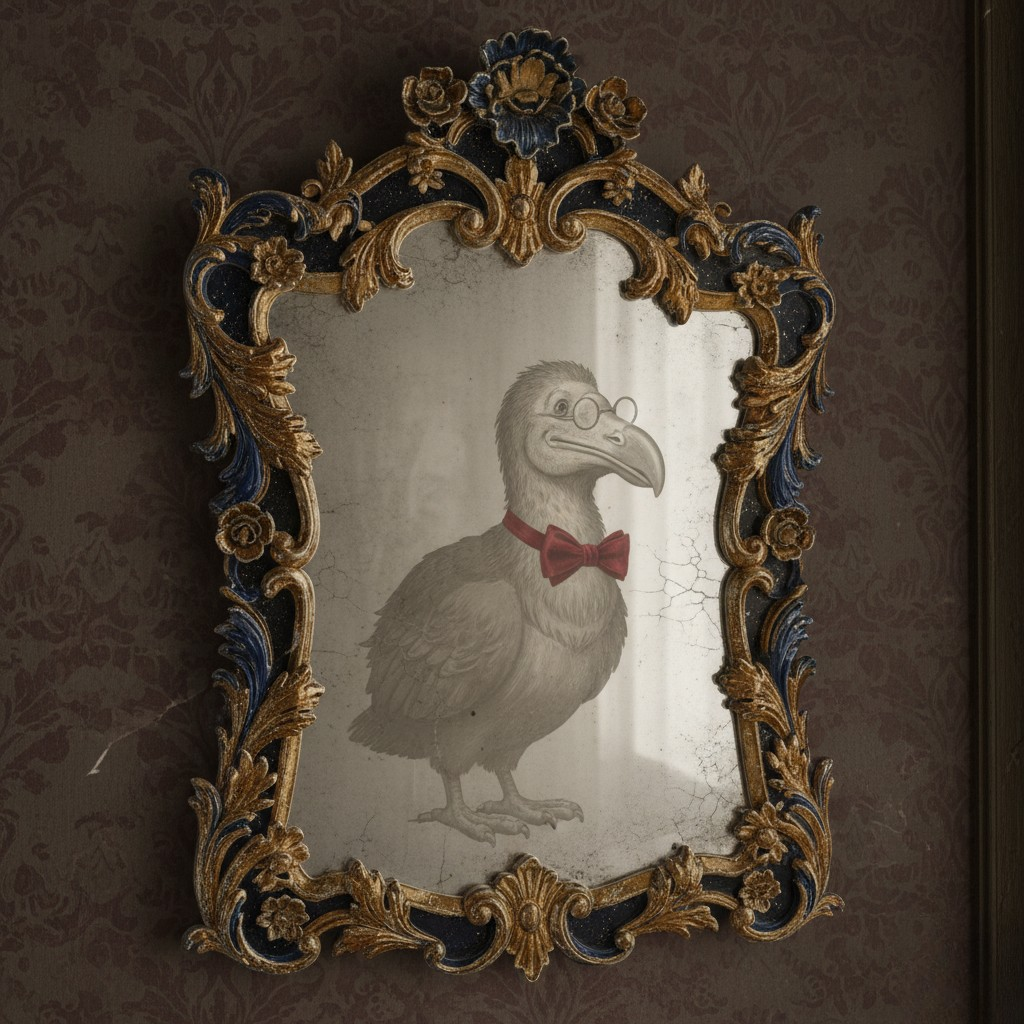
The dusty stillness of the abandoned manor is a well-worn tale, a commonplace backdrop for any adventurer worth their salt. Yet, as I navigated the maze of cobwebs and crumbling archways, my eyes were drawn to something that defied the general decay. A single, ornate mirror, its frame a symphony of rich blues and glittering golds, sat atop a dilapidated console. It was like finding a sparkling gem amidst a pile of ashes, and its perfection sent a thrill of curiosity through my spine.
Then and there I was startled not by my own reflection, but by an exquisite drawing etched directly onto the glass. The subject was no human, but a creature of whimsy: a dodo, impeccably dressed in a tiny red bowtie and a pair of spectacles. It was a caricature of intellect and propriety that seemed to grin back at me from the depths of the old mirror. For an uncomfortable moment, I wondered if that was a cryptic message, a clue to some hidden treasure or just a simple piece of art that had stood the test of time.
I was contemplating the bird when a low chuckle echoed through the silent hall. A dapper gentleman, a man who seemed to have stepped right out of a vintage photograph, appeared from the shadows. His face was etched with a mixture of amusement and weariness and a mischievous glint sparkled in his eyes. He identified himself as Lord Bisley, the former proprietor of the manor, or rather the ghost of its bygone glory.
With a sweep of his hand, he pointed towards the mirror, a wry smile playing on his lips.
‘Ah, I see you’ve met Archibald,’ he said, his voice a velvety baritone that seemed to carry the weight of centuries. ‘An eccentric fellow, Archibald. Thought he could save the dodos from extinction by teaching them ancient philosophy. This mirror was his crowning achievement, a testament to his noble endeavour.’
I couldn’t help but chuckle. The image of a dodo in a bowtie debating Plato was absurd, yet strangely endearing. The concept of trying to modernise an extinct species, of giving them a shot at survival through intellect and refinement, was both touching and utterly foolish. And yet, there was a certain beauty in Archibald’s quest, a reflection of the eternal human desire to control the uncontrollable and defy the inevitable.
‘You see,’ Bisley continued, ‘Archibald believed that if he could only instil in the dodos a sense of self-awareness and intellectual curiosity, they might somehow avoid the perils of their fate. He spent years in his study, sketching these elegant birds, each a portrait of a potential scholar or gentleman. This mirror was his ultimate creation, a portal into a world where dodos could be saved, not by the grace of goodness, but by the power of the intellect.’
As I listened to his story, a profound realisation washed over me. The mirror wasn’t just a quirky antique; it was a memorial, a tribute to a dream that had turned to dust. It was a reminder of the fragility of our aspirations, of the fact that even the most noble of intentions can be rendered meaningless by the relentless march of time.
Lord Bisley’s voice became softer.
‘Perhaps this is the real treasure of this manor,’ he said, his gaze fixed on the mirror. ‘Not some buried gold or ancient scrolls, but this single, whimsical reflection of a dream that refused to die.’
I left the estate that day with a new perspective, carrying with me not the memory of an abandoned ruin, but the image of a dapper dodo in a bowtie, a testament to the enduring power of dreams. And that, in a world full of shadows, was a treasure worth far more than any pile of gold.