Throughout their history, the Nobel committees have faced accusations of awarding prizes based on political interests, ideological bias and geopolitics rather than strict adherence to Alfred Nobel’s original mandate, as set out in his 1895 will. Directing one part of his fund towards literature, Nobel specified that the prize should go towards
The person who shall have produced in the field of literature the most outstanding work in an idealistic direction.
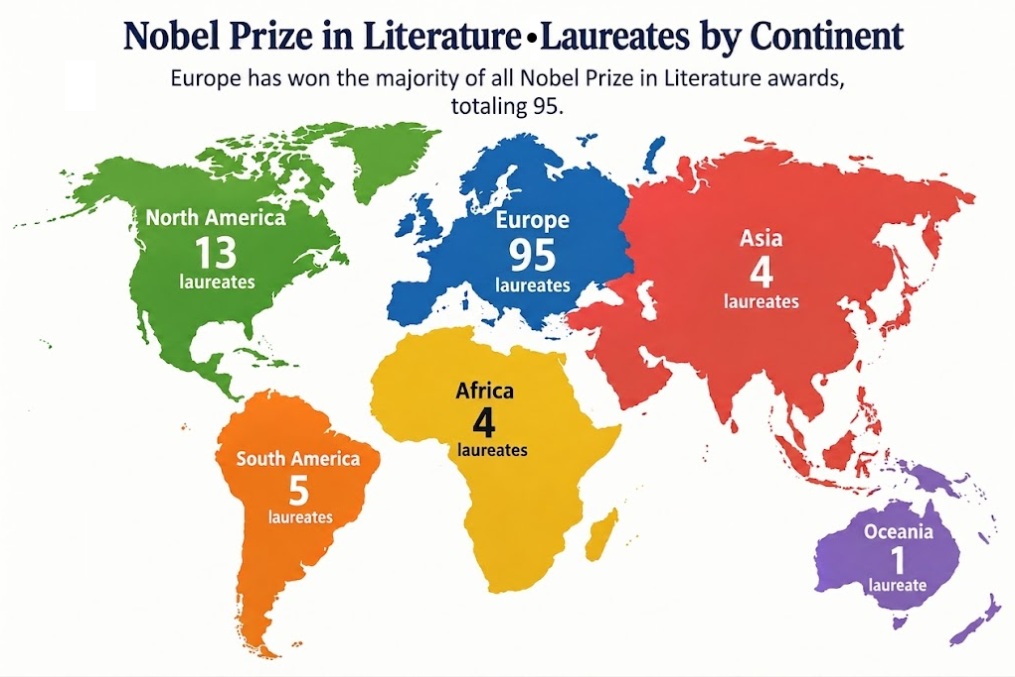
I offer no judgment and pronounce no sentence; the figures speak loudly enough for themselves. They outline a quiet, almost monstrous distortion hiding beneath the maths. The map makes this immediately apparent.
The numbers may fluctuate slightly across different sources due to differing interpretations of author details. These include dual citizenship, birthplaces that diverge from chosen home countries or even historical imperial territorial claims. However, the stark reality of this global imbalance remains unchanged and is difficult to ignore.
A vast majority of Nobel Prizes in Literature have been awarded to individuals from the Northern Hemisphere, highlighting a significant geographical asymmetry:
Northern Hemisphere: 112 laureates
Southern Hemisphere: 10 laureates
This profound geographical divide is not merely a statistical anomaly but a reflection of how the global literary hierarchy has been historically constructed. When a single hemisphere holds a near-monopoly on what is deemed ‘outstanding’, the literary map becomes distorted, mistakenly equating Eurocentric dominance with universal human merit. To challenge this asymmetry, the global community must look beyond the traditional, institutional borders. Rectifying this imbalance requires an active engagement with the rich, diverse and historically marginalised literary traditions of the Global South, a necessity most powerfully demonstrated by the vital, evolving canon of African literature.
The Decolonisation of Global Knowledge: African Literature and the Necessity of Universal Integration
In the global map of human thought, literature serves as the ultimate mirror of shared experiences, struggles and triumphs. For centuries, the concept of ‘Universal Letters’ (or World Literature) was viewed through a heavily Eurocentric lens, which often relegated non-Western narratives to the margins. However, a true understanding of the human condition is impossible without the inclusion of African literature. Studying and actively spreading knowledge about African literary traditions is not merely an act of academic inclusivity. It is a vital necessity for the decolonisation of global knowledge, the preservation of profound storytelling traditions and the enrichment of the universal literary canon.
For a magazine based in the heart of Europe’s publishing ecosystem, looking beyond our traditional literary borders is no longer merely a curious novelty. It is a vital intellectual necessity. Whilst EuroLit.net remains dedicated to celebrating European books and writers, we cannot ignore the sheer vitality, stylistic innovation and rich historical depth of African literature. We warmly salute every effort to bring these works to light, including impressive digital initiatives that highlight the real gems of the African literary landscape.
Reclaiming the Narrative and Decolonising the Mind
African literature possesses a vast history that long predates European colonial encounters. Its roots lie in complex oral traditions, epic poetry such as the Epic of Sundiata and early written works in Ge’ez, Arabic and local African scripts.
For generations, however, the global perception of Africa was heavily dictated by external viewpoints. These were often rooted in colonial biases that painted the continent as a monolith devoid of history or complex philosophy. In the mid-twentieth century, African literature emerged as a powerful force of resistance and reclamation. Pioneering writers like Chinua Achebe, Ngũgĩ wa Thiong’o, Wole Soyinka and Bessie Head redefined global letters by fusing local narrative modes with contemporary prose formats. Achebe’s novel Things Fall Apart, for instance, directly countered the colonial tropes found in European literature, demonstrating the power of self-representation. Today, a new generation including Chimamanda Ngozi Adichie, Abdulrazak Gurnah, Damon Galgut and Scholastique Mukasonga continues to command international acclaim.
To study African literature is to witness the dismantling of colonial myths. It allows readers to understand the profound trauma of colonisation, the euphoria and complexities of independence and the ongoing struggles of post-colonial identity from the perspectives of those who lived it. Spreading this knowledge ensures that the world engages with Africa not as an object of pity or exoticism, but as a subject of profound, self-determined intellectual depth.
The Bridge Between Orality and Text
One of the most unique and vital contributions of African literature to the global landscape is its seamless fusion of oral traditions (orature) and written text. Long before words were bound in books, local societies preserved history, philosophy and ethics through proverbs, epic poetry and the performances of griots.
Modern African writers, ranging from the mythological realism of Ben Okri to the folklore-infused plays of Nobel Laureate Wole Soyinka, have successfully woven these oral devices into written English, French, Portuguese and many indigenous languages. Studying this literature broadens our understanding of the universal definition of text. It teaches the global literary community new ways of experiencing structure, rhythm and narrative time, fundamentally changing how stories can be told.
Diversity of Thought and the Modern World
A common misconception is treating African literature as a singular genre. In reality, it is a vast, vibrant tapestry representing thousands of distinct cultures, languages and modern realities. The continent’s literary landscape spans an incredible stylistic and thematic spectrum:
* Post-Colonial Critiques: Masterpieces by authors like Ngũgĩ wa Thiong’o explore language, class and the politics of culture.
* Women’s Perspectives: Groundbreaking works by Buchi Emecheta, Flora Nwapa and Chimamanda Ngozi Adichie reshape universal feminist discourses through a distinctly African lens.
* Speculative Fiction and Afrofuturism: Contemporary writers like Nnedi Okorafor challenge the boundaries of science fiction, blending African cosmology with futuristic technology.
This resistance to a reductive, monolithic view of the continent is beautifully captured in contemporary poetry. Majekodunmi Oseriemen Ebhohon is a contemporary Nigerian playwright, poet and journalist. His concise poem Fifty-Five delivers a sharp, witty critique of these persistent external misperceptions[1]. Through a deceptively simple dialogue between the speaker and an unnamed figure, the piece dismantles the pervasive Western tendency to view Africa as a single, homogeneous entity rather than a vast expanse composed of 55 distinct nations.
The strength of the piece lies in its quiet irony and vivid imagery. Ebhohon builds a stark contrast between plain factual reality and the absurd insistence of the listener:
There are are fifty-five countries in Africa,
but this man keeps looking
for the one called Africa.

I draw him a map,
then another map,
and watch him grow suspicious
of basic maths.

He asks if the countries are provinces,
if the borders are decorative,
if perhaps Africa is one enormous country
that forgot to choose a president.

I say the number fifty-five again,
slowly,
the way you explain a seatbelt
to a toddler.

He writes it down carefully,
as if numbers might grow teeth
and bite him

if left unsupervised
in the hands of Africans.
* Deconstructive Humour: The poem uses absurdity to highlight ignorance, particularly in the lines where the listener wonders if borders are decorative or if the continent is ‘one enormous country that forgot to choose a president’.
* Patience Versus Patronage: The speaker’s tone remains remarkably calm, explaining basic geography ‘the way you explain a seatbelt to a toddler’. This inversion subverts historical colonial dynamics by casting the outsider as the child unable to grasp basic reality.
* Underlying Political Bite: The final stanza moves beyond light satire to land a subtle punch regarding authority and prejudice, noting how the listener treats simple facts cautiously ‘as if numbers might grow teeth and bite him if left unsupervised in the hands of Africans’.
By anchoring the narrative in a basic arithmetic truth, Ebhohon uses brevity to maximum effect. Fifty-Five serves as both an entertaining piece of social commentary and an essential reminder of the nuance that global readers often overlook.
Bridging the Institutional Divide
Despite these artistic triumphs, the Global North must do far more to actively study, support and spread knowledge about African letters. Too often, European and North American publishing limits African authors to narrow anthropological categories or expects them to serve solely as commentators on trauma, conflict and post-colonial politics. In reality, African authors produce groundbreaking science fiction, subtle romance, intricate crime novels and profound philosophical essays.
The responsibility to correct this lies heavily on northern platforms, which still have a long way to go in actively cross-promoting and discovering continental literary hubs. Independent online directories and digital communities, such as the Nigeria-based ‘African Literature’ platform in Ile-Ife, have successfully built dedicated follower bases of tens of thousands of readers. Yet, because global algorithmic and marketing systems remain siloed, European and North American readers rarely engage with these indigenous spaces.
Building a truly reciprocal dialogue requires a concerted effort from European cultural institutions, publishers and readers through concrete systemic shifts:
* Translation Investment: European houses must fund direct translations from indigenous African languages rather than relying solely on Anglophone, Francophone or Lusophone texts.
* Curricular Inclusion: European universities and schools must integrate African classics alongside European canons to combat what Chimamanda Ngozi Adichie defines as ‘the danger of a single story’.
* Publishing Equity: Northern publishing platforms should foster genuine partnerships with African independent presses to respect local copyright and royalty ecosystems.
Conclusion: Completing the Universal Canon
No library of ‘Universal Letters’ can claim completeness if it silences or ignores the voices of an entire continent. African literature is not a niche sub-category to be studied only out of political correctness; it is a foundational pillar of human artistic achievement.
By widening our editorial scope, European readers gain access to fresh narrative structures and vital worldviews. Bridging this gap enriches our collective literary culture and ensures that great books from across the African continent receive the enduring recognition they deserve. To embrace African literature is to finally allow World Literature to be truly universal, creating a global cultural dialogue where every horizon is visible, respected and shared.
[1] While standard diplomatic counts often cite 54 internationally recognised sovereign states, the poem’s figure of 55 reflects the full membership of the African Union, which includes the Sahrawi Arab Democratic Republic (Western Sahara).