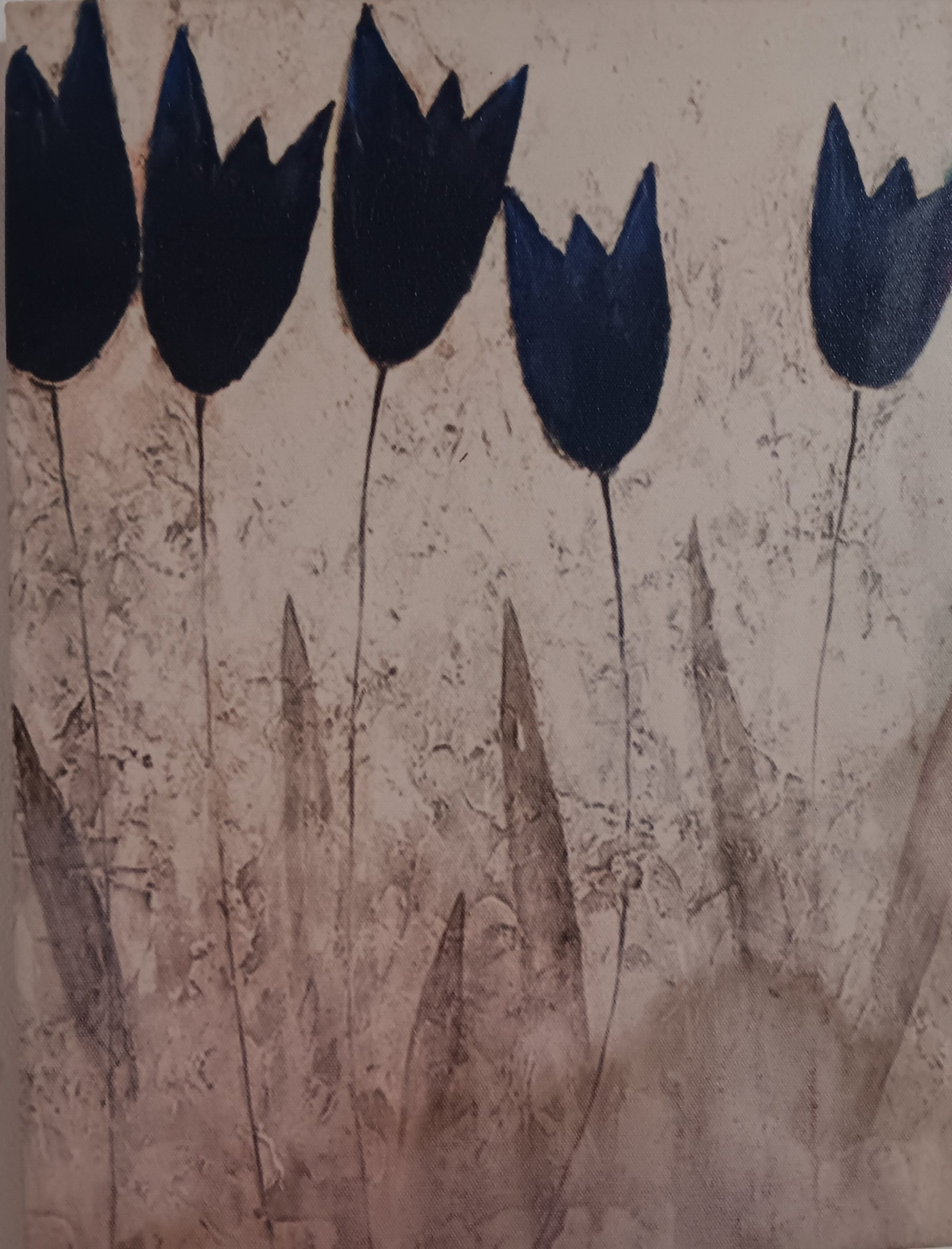
Our story takes place in the very country where the play of Romeo and Juliet was completely banned for ‘promoting paedophilic attitudes towards minors’. Yes, unfortunately, it was this same nation where our team of biologists managed to engineer the most perfect black-hole tulips in existence. Within days, however, those same vigilant authorities prohibited using the word ‘black’ to describe the century’s most extraordinary bio-discovery, claiming it was ‘a defamatory term and we do not tolerate racism among plants’.
▼
The laboratory, nestled deep within the hilly countryside, was a modest affair, but its garden was legendary. Inside the green allotment lay a specific flowerbed, dedicated only to the strangest of experiments. Here, Brígida Tolmes, a Nobel-worthy botanist with a fondness for the unnatural, grew her ‘Midnight Shades’.
For years, she had cross-bred tulips, seeking a bloom that defied colour. They were not merely black or deep purple, for those held light. These tulips were designed to absorb it. In the high summer, when other flowers fought to be the brightest, the Shades stood, singular and eerie. From their textured ground, a grey soil she had composed of crushed organic sedimentary rocks, volcanic ash and desiccated bone powder, the very first five flawless, dark blue-black ink-stained spears would rise. Their slender stems, the rough, dry texture of the soil – it was all there, rendered with a simplicity that only highlighted the alien nature of the things she had created. The tulips were the darkest part of the test bed, even when the lamps were on.
Her neighbours were wary. They claimed that even in full sun, a shadow lingered over the Shades’ bed. Old Mr Jenkins, the scientist’s granduncle, who had once peeked over the wall, swore he could feel a chill near them, a cold that had nothing to do with the wind.
‘They’re not natural, Brígida,’ he’d huffed. ‘They look less like flowers and more like a line of sentinels waiting for the sun to fail.’
She only smiled, knowing the real power of the things. They had been bred not just to reflect nothing but to siphon warmth, to be a void. This particular triumph was a study from the year she finally achieved perfect light absorption, like a dear memory of her victory.
Yet that victory was short-lived, as the overzealous authorities soon descended upon the property with armed officers and bureaucratic warrants to officially close the laboratory. Citing severe public non-compliance regarding botanical-political correctness, the team destroyed the carefully cultivated garden, uprooted every bed and formally placed the offending black tulips under arrest to be impounded as contraband.
▲
Stripped of her life’s work, Brígida watched the rain from her study window. All she had left was a single painting of her century’s greatest discovery. It was a perfect match: the stark forms against the dry ground, a line of darkness that the pale moonlight couldn’t touch. As she stared at the canvas, she wondered if the chill her relative felt was just an illusion, or if she had bred something that truly was a cosmic void. Now officially censored.