
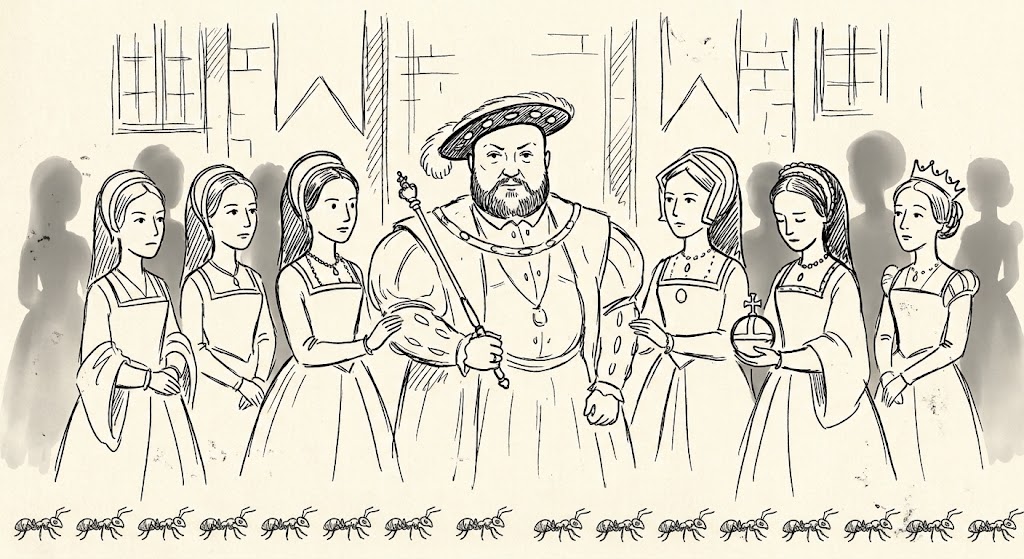
To the foreign ambassadors, King Henry was a monarch of immense size, suffering from grand political anxieties; to his Privy Council, he was simply a man with an incurable case of ants in his hose. In truth, the grand machinery of the Tudor state was constantly being rewritten for one simple reason: His Majesty was forever seeking a new pair of eyes to soothe his perpetual itch.

Henry VIII had a curious way of falling in love. He did not merely fall. He plunged, tumbled and occasionally dragged an entire kingdom after him.
Everything began innocently enough with Catherine of Aragon. She was regal, devout, profoundly patient and originally imported to marry his elder brother, Arthur, whose sudden death left Henry to claim both the crown and his widow. For twenty years she endured Henry’s boisterous moods, but as the lack of a surviving male heir weighed on his mind, the royal breeches began to twitch.
Henry’s attention began to wander.
First came Elizabeth ‘Bessie’ Blount, a maid of honour whose charms temporarily soothed the King’s fidgets and produced a healthy illegitimate son, Henry FitzRoy. Not long after, Henry’s gaze shifted to Mary Boleyn. Mary was sweet-natured and accommodating, yet the royal pants remained stubbornly unsatisfied.
Then came Mary’s sister, Anne.
Anne Boleyn refused to be a mere mistress, effectively trapping the royal ants in a vice. For seven long years, Henry tore down monasteries, broke away from Rome and rewrote the laws of England just to get into Anne’s good books (and skirts). They married, but when Anne produced the sharp-witted Elizabeth rather than a prince, the King’s hose grew agitated once more. A tragic, controversial date with a transplanted French swordsman on Tower Green cured that particular itch.
Eleven days later, Henry married Jane Seymour. Jane was gentle, meek and remarkably quiet. She succeeded where the others had failed by bearing him Prince Edward, but her sudden death from childbed fever left the King heartbroken and, briefly, still.
The stillness did not last. Thomas Cromwell, attempting to manage the royal restlessness, arranged a marriage with Anne of Cleves based on a flattering portrait by Hans Holbein. When the German princess arrived in person, fluent in nothing but her native tongue, Henry took one look, declared her a ‘Flanders mare’ and complained that his hose had never felt so utterly devoid of enthusiasm. The annulment was secured in months, though Anne got a generous settlement and sensible peace of mind out of the bargain.
Instantly, the royal fidgets returned with furious intensity, leading Henry straight to Catherine Howard. She was barely in her teens, vivacious and foolish. For a moment, the ageing monarch felt twenty again. Unfortunately for Catherine, her own youthful indiscretions caught up with her, and she followed her cousin Anne Boleyn to the scaffold.
By the time Catherine Parr arrived, King Henry was bloated, ulcerated and thoroughly exhausted. Catherine was sensible, highly educated and adept at managing both the Tudor children and her husband’s volatile temper. She acted more like a devoted nurse than a grand romance, finally smoothing down the ruffled velvet of the sovereign’s wardrobe.

Henry’s wives had been queens, diplomats, scholars, mothers, survivors and victims. Meanwhile, he had spent much of his adult life treating marriage as both a political institution and a solution to his latest romantic obsession.
Six wives later, when he finally died in 1547, leaving behind three legitimate children and a damaged reputation, the Kingdom let out a collective sigh of relief. The crown had survived, the dynasty was intact and, at long last, the royal trousers were finally at peace.





Fantasic ants in his pants indeed 🤣😂