It was a matter of gravity, propriety and basic lexicography. In the mid-eighteenth century, while lesser minds fretted over taxes or the French, Sir Horace Honorius Hunt of Inverness dedicated his waking hours to a singular cosmic injustice: the celestial map.
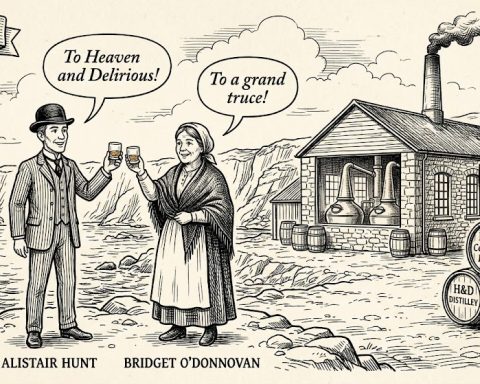
‘Consider the utter lack of symmetry, my dearest,’ Sir Horace declared one blustery evening over a dram of single malt. He gestured towards the crackling hearth of the Highland estate where the Royal Highland Society had just been founded. ‘The Creator fashioned the firmament with grand order, yet we are expected to accept that the ultimate dwelling of the righteous and the fiery pit of the damned do not share a neat, symmetrical pairing? It is untidy. It lacks poise.’
Lady Hannah, sitting gracefully by the window, nodded in solemn agreement. She was a woman of formidable intellect and boundless patience. ‘Directly so, Horace. The aspirate ‘H’ possesses a majestic, airy spirit. The breath of life itself! Heaven and Hell have been left to standard spelling merely by dreadful accident. They must both be explicitly bonded under the same letter to preserve balance.’
For forty years, the noble pair laboured hard: they wrote pamphlets, lobbied the clergy and held grand symposia in Edinburgh. They argued that the ‘H’ in Hell stood for Hope lost, while the ‘H’ in Heaven stood for Hope fulfilled. They made it their life’s work to prove that both realms were bound by that singular, noble breath.
Meanwhile, a mere sixty miles across the North Channel in County Antrim, two people held a vastly different, far more tempestuous view.
Declan O’Donnovan and his beloved wife Deirdre had spent their youth arguing with anyone within earshot, plus several who were actively trying to escape, that the Scots had it entirely arse-ways.
‘An ‘H’?’ Declan spat into the turf fire, his face turning the colour of a ripe beet. ‘An ‘H’ is nothing but a soft gasp, Deirdre! A whisper for folk who can’t make up their mind! The underworld needs bite! It needs a hard, ringing consonant!’
‘Aye,’ Deirdre agreed, slapping the wooden table with a hand calloused from years of churning butter and writing angry letters to the Bishop of Armagh. ‘It’s Dell for the deep, dark depths and Deaven for the divine daybreak. It has a lovely rhythm to it. Dell and Deaven. A grand Irish pair!’
The O’Donnovans launched a fierce counter-campaign across the emerald hills. They hoisted banners, recruited local bards to sing ballads of Dell and Deaven and sent frantic missives across the water. A terrible feud erupted across the Irish Sea. The Scots insisted on the double ‘H’ out of high-minded Highland virtue, while the Irish fought tooth and nail for the double ‘D’ out of sheer, unyielding stubbornness.
Matters reached a climax in the autumn of 1789 at the Great Cartographic Summit on the Isle of Mull.
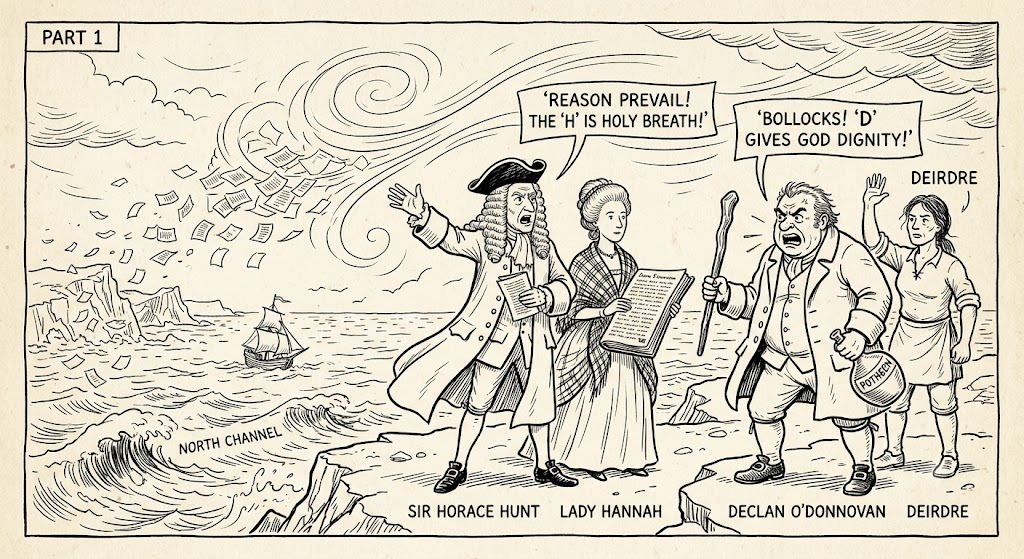
Sir Horace, by then an elderly man with a magnificent silver wig, met Declan O’Donnovan on a windswept cliff edge. Lady Hannah stood beside her husband, holding a leather-bound parchment containing three thousand pages of theological proof. Deirdre O’Donnovan stood opposite, holding a heavy wooden shillelagh and a gallon of potheen.
‘Good sir,’ Horace began, his voice booming over the gale. ‘Reason must prevail! The ‘H’ represents the holy breath!’
‘Bollocks!’ shouted Declan, his coat flapping wildly. ‘The ‘D’ gives the Devil his due and God His dignity! Dell sounds like somewhere you’d actually fear going, whereas your Hell sounds like a meisceoir clearing his throat!’
The debate raged for seven hours. Arguments were traded, Scottish proverbs were hurled like cobbles and Irish curses turned the sea foam green. Lady Hannah attempted to mediate with tea, but Deirdre accidentally knocked the teapot into a wild bush.
As twilight fell, a monstrous gust of wind whipped up from the strait. It caught Lady Hannah’s three-thousand-page treatise and scattered the leaves across the Atlantic. Simultaneously, a stray wave leaped over the crags, soaking Declan’s carefully drafted Gaelic petitions until the ink ran into a muddy violet blur.
The four combatants stood soaked, exhausted and entirely out of breath, watching three thousand pages of theological genius bob gently towards Iceland.
‘Well,’ Lady Hannah remarked, wringing out the hem of her tartan shawl with quiet dignity. ‘That was thoroughly unhelpful.’
‘Aye,’ Declan muttered, wiping sea spray from his eyes and handing Sir Horace a flask of potheen. ‘A grand disaster altogether.’
They sat upon the damp rocks in weary silence, sharing the fiery spirit while the wind howled around them. In the end, neither side had the energy to rewrite their manifestos. The English printers, thoroughly confused by the endless cross-channel bickering and unwilling to reset their printing presses, simply published the maps as they were: keeping the ancient Scottish ‘H’ for both locations just to avoid further brawls at the docks.
To this day, the ultimate destinations of human souls share an opening letter. The Highland Society claims it as a triumph of heavenly logic, while the O’Donnovans’ descendants still sit in Antrim pubs, nursing dark stouts and swearing blind that the world lost its finest alliteration to a bad breeze and a couple of stubborn Scots.
[ To be continued … ]