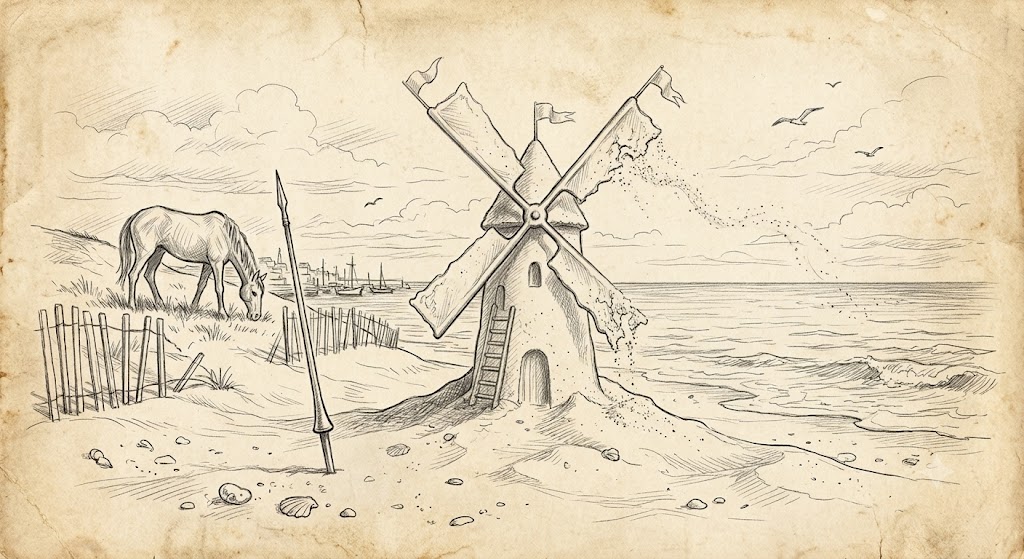
The blazing sun beat down on the castle-less shoreline, a cruel mockery of the joy it once brought Don Quixote. Since it had recently become illegal to build sandcastles in Spain, as a result of some baffling municipal decree, naturally, our hidalgo-knight-errant decided to happily tilt at sand windmills.
‘See, Sancho,’ said he, ‘this is what I call a clear case of tyranny: the practice of making today’s legal into tomorrow’s illegal. It’s unfair, so it cannot stand for long.’
Sancho, always the pragmatist, wiped a bead of sweat from his brow.
‘But good master, the new decree is quite clear: no sandcastles. The fines are considerable, and I’ve no desire to see Rosinante impounded for a pile of sculpted sand.’
Don Quixote scoffed, adjusting his cracked helmet. Then suddenly, a spark of inspiration lit his eyes. He leaped directly to a conclusion, a style that Sancho had learnt to both dread and admire.
‘They clearly forbid castles, yes, but they say nothing of windmills!’ He laughed victoriously. ‘Fines, you say? Impoundment? Nah! We shall build monuments to industry, Sancho! Towers of aspiration, harnessing the very breezes that whisper tales of freedom across all these forbidden sands!’
Sancho groaned inwardly. He had hoped for a quiet afternoon of napping and perhaps a small illicit sand turtle. Instead, he found himself digging. Don Quixote, with surprising vigour for a man of his age and delusions, began to sculpt, his hands moving with the precision of a master builder.
‘Sancho,’ he declared, his eyes ablaze with a familiar, if slightly more granular, madness, and his voice a dramatic whisper against the gentle lapping of waves, ‘thou art not used to this business of adventures. We build giants here! Therefore, betake thyself away while I engage them in fierce combat.’
Soon, a peculiar structure began to rise from the sand. Not the intricate battlements and turrets of a castle, but a series of cylindrical towers, each adorned with broad flat blades designed to catch the sea breeze. Sancho, under his master’s unwavering gaze, lugged buckets of wet sand, muttering about the futility of it all.
‘Imagine, Sancho,’ Don Quixote mused, stepping back to admire the handiwork, ‘each rotation a tiny whisper of rebellion! Each grain of sand a defiance against the arbitrary, a challenge to the oppressive tide of bureaucracy!’
As the afternoon wore on, a small fleet of sand windmills dotted the beach. They were undeniably charming, if a little lopsided, their sandy vanes turning lazily in the gentle breeze. A few children, initially confused, soon found joy in watching the peculiar structures, giggling as the wind caught a blade and sent a shower of sand spiralling.
Unfortunately, the children’s ecstatic shrieks were too much for a random, irritable informant whose next-day headache was intensified by their yells, and who immediately alerted the beach patrol.
A stern and unyielding officer approached.
‘Sir,’ the officer began, his voice flat, ‘I observe … structures. On the beach. And while I see no turrets or drawbridges, I must inquire as to their nature.’
Don Quixote puffed out his chest.
‘These, good sir, are not castles. These are sand windmills! Harmless, productive and entirely within the letter of your … peculiar law!’
The officer stared, then slowly, a faint, almost imperceptible smile touched his lips. He looked at the turning vanes, at the delighted children and then back at the earnest, slightly deranged knight. He cleared his throat.
‘Indeed. Windmills. Most … innovative. Carry on, gentlemen.’
Sancho exhaled slowly as the officer walked away, shaking his head.
‘Master,’ he said, ‘I am lost for words. We have built nothing, yet achieved everything.’
Don Quixote, beaming, adjusted a loose vane on their grandest windmill.
‘Indeed, Sancho. For even in the face of absurdity, the spirit of ingenuity, like the wind itself, cannot be legislated away.’
He then promptly declared that their next project would be a sand galleon, completely unaware of the irony. Sancho merely sighed and began to eye the incoming tide, hoping it would bring a swift, merciful end to their architectural endeavours. But he knew better than to hope for peace. For in the heart of Don Quixote, every beach was a battlefield, every grain of sand a challenge and every impossible idea was merely the blueprint for the next glorious, absurd and entirely necessary adventure.