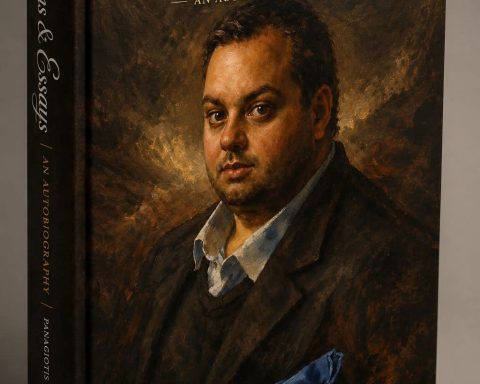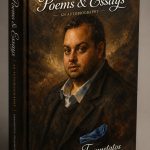
I read the piece once, and it sounded like a beautifully crafted essay on pure presence and meditation. Then I noticed that something was missing from my simple categorisation, so I read the text a second time. Now, it felt more like a prose poem, intensely focused on rhythm and imagery. Before I go further, I invite you to read Panagiotis Tzannetatos’s text and decide for yourselves: essay or poem?
The Timeless Summer of Existence
There are days when the light falls straight down, without mercy, yet without force. Days when the earth breathes slowly, as if it has accepted the weight of its own existence. Nothing demands an explanation. The world does not explain itself – it simply exists. The sun scorches what is excess and spares only the essential: a shadow beneath an olive tree, the salt on the skin, a stone that remains silent, promising nothing.
In this unyielding light, there is no room for dreams of what comes next. The present, whole and undivided, demands to be lived without leaning into before, without longing for what comes after. Joy is not noise; it is clarity. It is to look without question, to live without denial, to die a little within each moment and yet not to mourn.
Here, within the absoluteness of day, silence is complete, and life stripped of meaning becomes sacred.
And so, in this timeless summer, where Being unfolds like a breath in the light, you learn that no purpose is needed to exist, only the simplicity of Being, like light that asks for nothing in return.”
If you ask me, then my answer is Yes:
It can absolutely be categorised as an essay, specifically a philosophical essay, as the piece is doing distinct intellectual work alongside its beautiful imagery. It perfectly fits into a long and celebrated tradition of literary essays. Writers like Albert Camus (The Myth of Sisyphus) and Ralph Waldo Emerson (Nature) frequently used highly poetic prose to explore deeply philosophical arguments.
But also Yes:
It also qualifies as a prose poem, because the text values the music of the words just as much as the literal message. The author uses sensory metaphors (the olive tree, the salt, the scorching sun, the silent stone) to evoke an emotional and psychological state rather than relying on a structured logical argument.
The Verdict: A Lyric Essay
If you are looking for the most accurate literary term to define a text that masterfully combines the philosophical inquiry of an essay with the rhythmic texture of poetry, prioritising meditation and atmosphere over strict narrative chronology, it is a lyric essay. By stopping right at the intersection of both genres, we can honour its poetic beauty without stripping away its philosophical weight. Panagiotis Tzannetatos isn’t just painting a pretty picture with words; he is exploring a profound truth about human existence.
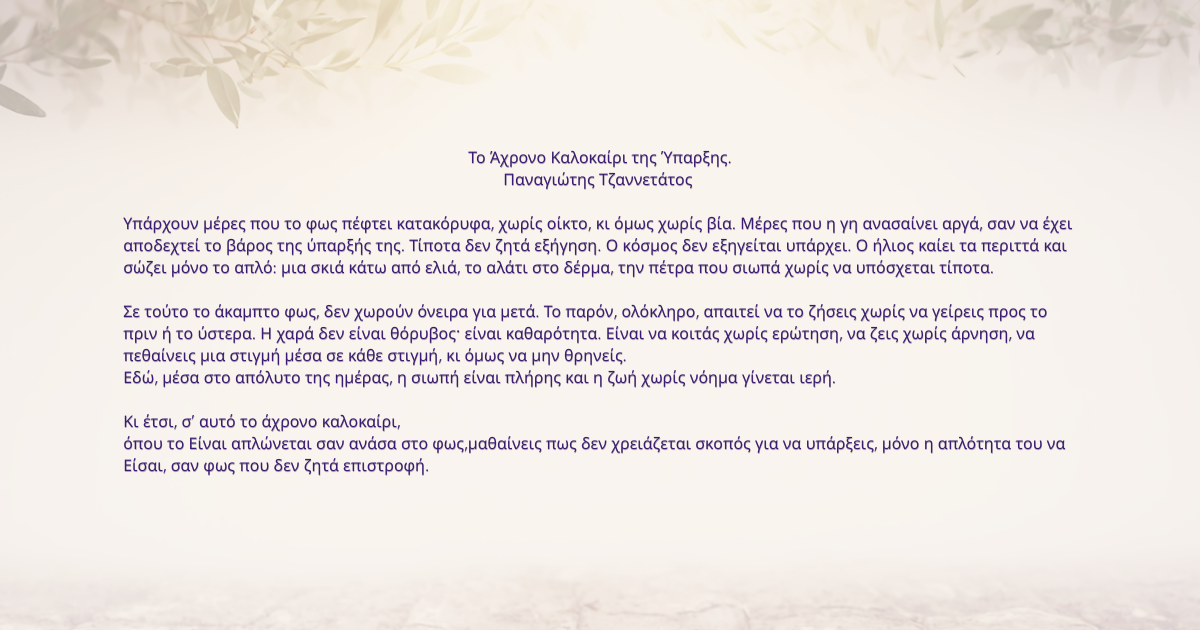
Editor’s Note: For those of you who can speak or read the language of Odysseus’ descendants, you will find the original text beautifully presented in the image.