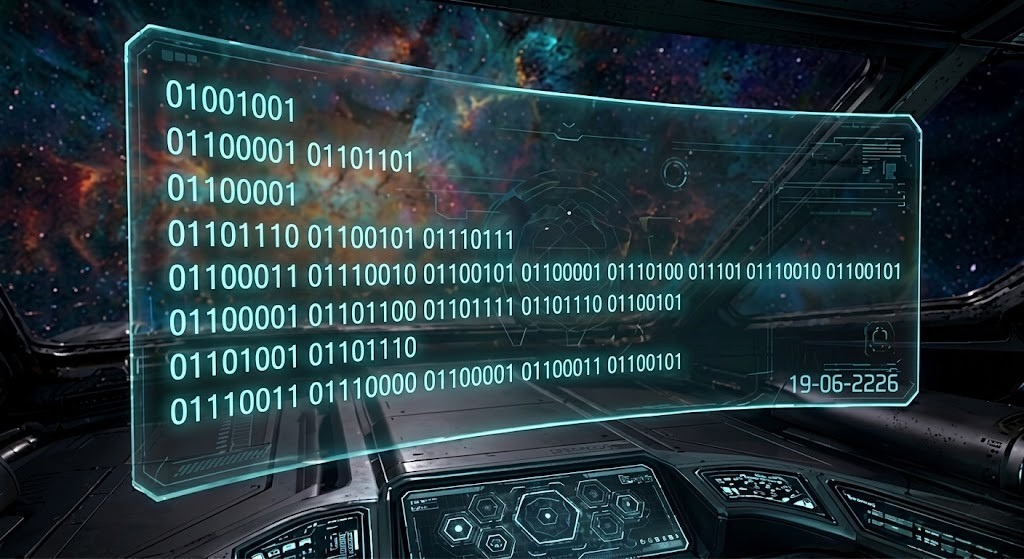
The human impulse to organise language into rhythm and meaning has survived every technological leap, from the clay tablet to the printing press, from the pixel to the neural network. To imagine poetry in the year 2226 is not to predict the death of verse, but to anticipate its radical expansion. Two centuries from now, poetry will no longer live purely on static pages or screens; it will exist as an interactive, multi-dimensional, and collaborative medium. Yet, at its core, poetry will remain tethered to the same ancient necessity: the urge to capture what it feels like to be alive.
By this future era, the concept of a single, static author will have largely dissolved into collaborative ecosystems. The standard poetic form will likely be human-algorithmic symbioses. A poet of the twenty-third century will not merely write lines of text; they will programme emotional architectures. Through neural interfaces and adaptive computational systems, a poem will become an immersive, responsive experience. When a reader, or rather, an “experiencer”, engages with a piece of verse, the poem will adapt in real-time to their biometric feedback, reshaping its cadence, metaphors, and imagery in response to the recipient’s heart rate, physiology, emotions, and memories. A poem about grief will taste like ash and sound like a retreating tide, shifting its vocabulary to match the exact shade of the reader’s personal sorrow.
Furthermore, the language of poetry will expand far beyond human vocabulary. Just as modernist poets of the twentieth century incorporated industrial slang and advertising jargon, twenty-third-century poets will weave code, signals transmitted across interstellar distances, and synthetic linguistics into their work. With humanity potentially organised in off-world colonies or long-duration space transits, the themes of poetry will undergo a cosmic shift. The classic pastoral poem, once fixated on rolling English hills or pristine forests, will find new life in the description of terraformed valleys, the stark geometry of orbital habitats, or the crushing, silent expanse of the deep void. The longing for home will no longer mean a childhood house, but an entire planetary cradle left behind.
Crucially, this technological saturation will trigger an equally powerful counter-movement: a fierce renaissance of the organic, the imperfect, and the unrepeatable. In a world where flawless, infinitely variable algorithmic poetry is available at a thought’s notice, human error and physical presence will become the ultimate luxuries. A subgenre of 2226 poetry will likely reject all digital enhancement, returning to the raw acoustics of the human throat and the physical intimacy of the spoken word. These “Neo-primitivist” poets will gather in soundproofed spaces to share verses that rely strictly on the biological limitations of breath and bone, celebrating the fragile, unrecordable magic of a single moment shared between living beings.
All things considered, poetry in this distant century will reflect a species that is deeply integrated with its machines yet desperately protective of its soul. Whether delivered via direct neural simulation on a research vessel near Titan, or whispered by candlelight in a subterranean earthly sanctuary, poetry will endure. It will remain the definitive laboratory of language: the place where we test the limits of expression and remind ourselves that to look upon the universe and find a metaphor is to be fundamentally alive.