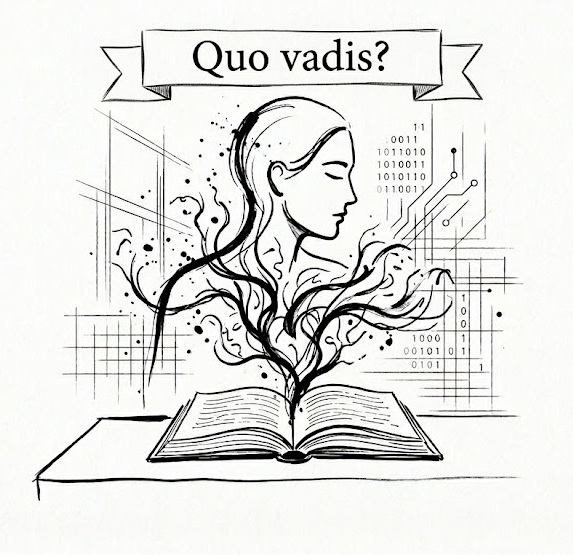
The landscape of literature in 2026 is defined by a fascinating paradox: the more universal and invisible the technology becomes, the more fiercely protective readers and writers are of the human soul behind the page. We are no longer speculating about how digital transformation or artificial intelligence will change books; we are living in the reality of their integration. Today, literature exists at a vibrant, somewhat chaotic crossroads where human emotional depth remains the ultimate currency, forcing us to ask the ancient question, Quo vadis? (Where are you going?), even as the infrastructure supporting the written word undergoes a structural revolution.
The Present: Emotional Realism and Genre-Blurring
Looking at the book trade today, the dominant thematic current is a distinct craving for grounding and intimacy. The hyper-optimised, aggressive hustle culture non-fiction of the late 2010s and early 2020s has largely faded. In its place, the most successful non-fiction focuses on emotional resilience, long-term well-being, and structured reflection.
In fiction, this manifests as a deep commitment to emotional realism, even within highly imaginative spaces. While Fantasy and Romantasy continue to dominate physical bookshops and algorithmic spaces like BookTok, the subtext of these stories has shifted. Readers are less enamoured by distant heroes or far-flung dystopias; instead, they are drawn to speculative fiction rooted in reality. The prevailing question in 2026’s fiction is intimate: How do human relationships, identity, and communities survive under the quiet anxieties of near-future technology and a changing climate? Furthermore, the strict boundaries of genre have effectively collapsed. Literature today is flexible, unbothered by rigid categorisation, and hyper-focused on delivering an authentic psychological experience.
The Machine in the Background: Infrastructure and Publishing
Behind the creative text, the mechanics of publishing have quietly automated. In 2026, the initial panic that generative AI would completely replace authors has settled into a pragmatic realisation: AI can be seen as an infrastructure tool, not a creative authority.
Large publishing houses and independent authors alike now routinely use machine learning to optimise metadata, run early-stage cover art concepts, translate texts, and analyse market trends. Audiobooks have hit an all-time high in consumption, fully integrated into the publishing cycle. While automated text-to-speech voices handle high-volume backlists and academic titles, major platforms have actually increased their hiring of human voice actors for tentpole releases, proving that listeners still demand the nuanced emotional delivery of a human performer.
Simultaneously, the industry is moving away from single-gatekeeper dependency. While Amazon remains the titan, 2026 has seen a massive push towards diversified distribution. The rise of reputable hybrid publishing models, which offer professional editing and distribution pipelines while allowing authors to keep higher royalty percentages, has matured into a widely respected tier of the industry. Authors are more contract-literate and business-savvy than ever before, treating publishers as collaborative partners rather than gatekeepers to a holy grail.
The Future: Where Literature Goes Next
As we look beyond 2026, the trajectory of literature points towards a deeper fragmentation and simultaneous democratisation of the written word.
Future writers will likely fall into two camps:
• ‘Traditionalists’, who will maintain a clean line between human creation and machine assistance, using AI purely for editing or outlining, and
• ‘Collaborators’, who will openly co-write, treating algorithms as collaborative brainstorming partners to generate dense, branching interactive narratives.
As the digital ecosystem becomes increasingly saturated with synthetic content, human-crafted literature will command a premium. We are likely to see the emergence of verified human-author registries or cryptographic stamping to assure readers that a text was born of lived, organic human experience.
With fluctuating attention spans and changing consumption habits, short-form literature, such as intentional short story collections, fluid, serialised novellas, and audio-first epistolary stories, will continue to gain cultural capital. Books will increasingly become living documents, with authors updating text or releasing alternate perspectives dynamically to close-knit community hubs.
Concluding Thoughts
Literature today is neither dying nor being entirely mechanised. It is adapting. The core of what makes literature vital (the radical act of stepping inside another mind to glimpse a truth that feels entirely real) remains fiercely unchanged. Technology has altered how books are packaged, discovered, formatted, and sold, but it has only deepened our hunger for stories that are undeniably, beautifully true to the human condition.