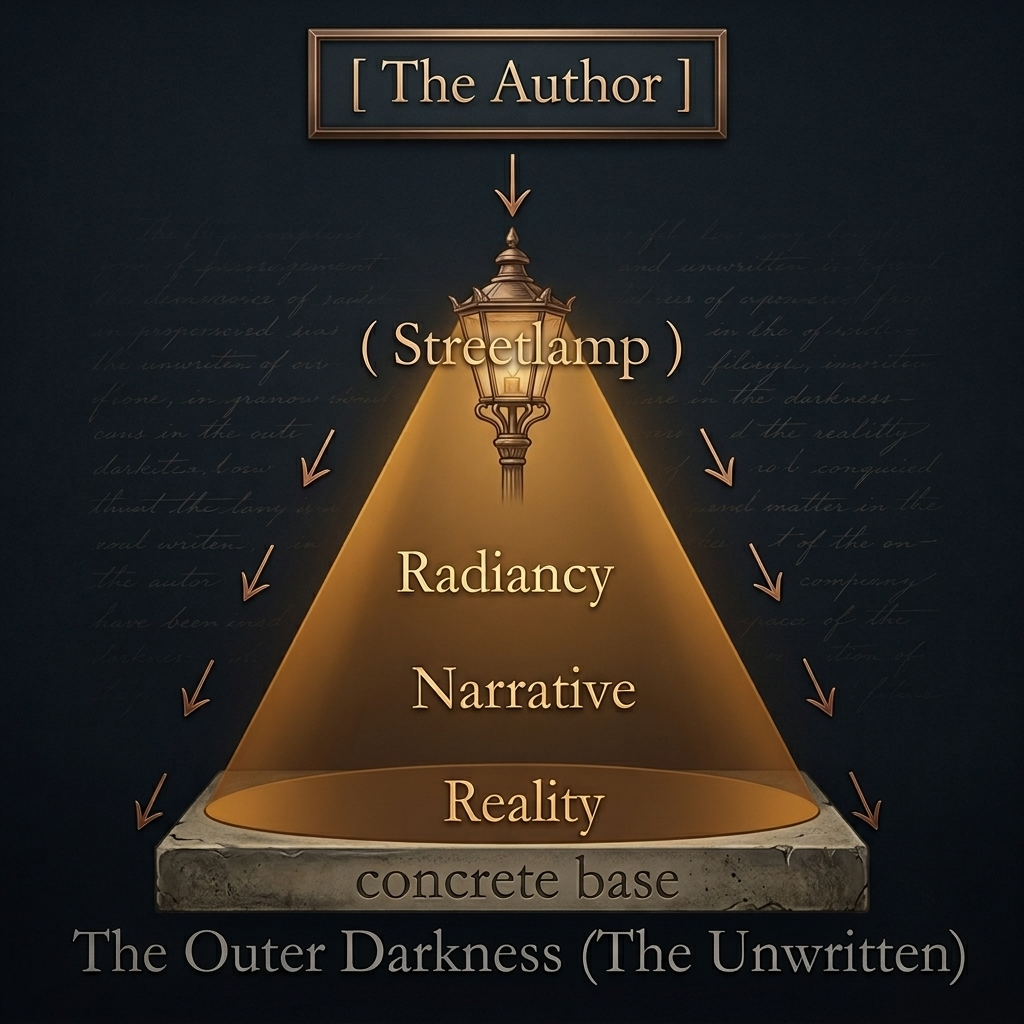
If this were a traditional script, I would tell you that the lamp outside my window is casting a conical sanctuary of amber light against the creeping dark, symbolising the fragile perimeter of human knowledge. I would weave a metaphor about how we only see what is illuminated, leaving the vast, terrifying scenery of the unknown to fester in the shadows.
But let us be honest: I am sitting in a high-back chair staring at a blank Word document, the lamp outside my window is buzzing with a petulant, electric sizzle. It really sounds like a clearing throat. And you? You are lounging in an armchair or nestling in a warm bed, reading a text that is acutely aware of its own artificial scaffolding: The streetlamp is not just a symbol; it is a plot device. I am using it to make you think I am an observant writer working late into the night. Which, ironically, I am.
The Anatomy of the Cone
Unlike the flashlight, the streetlamp cannot move. It is attached to its concrete base, much like an author is attached to their specific preferences.
Anything that walks into the light becomes suddenly, agonisingly relevant. A discarded fizzy drink can look like a cathedral; a passing stray black cat becomes a premonition. One step out of the amber circle, and characters cease to exist. They are not dead; they are simply suspended outside reality.
When I conceive a character into the light of my metaphorical streetlamp, I am creating them from scratch. I give them a damp trench coat because it suggests rain, which saves me from having to describe the weather across the entire city. I give them a limp because it implies a past, sparing me the trouble of writing a prologue.
—
The trap of the streetlamp world is that we, both readers and writers, begin to believe the circle of light is the entire world. We mistake the boundaries of the page for the boundaries of existence.
In the spirit of Jorge Luis Borges, Umberto Eco, or Italo Calvino, one might say: “The history of literature is the history of authors trying to convince readers that the dark does not exist, while secretly being terrified of what is hiding in it.”
But what happens when the author deliberately breaks the bulb?
In a metafictional text, the streetlamp begins to flicker. The character in the trench coat stops under the light, looks up past the glass housing, looks directly through the screen you are reading this on, and asks: ‘Who’s holding the pen?’
Suddenly, the illusion of the narrative collapses. The reader is forced to realise that the amber light was not showing them reality; it was merely showing them a carefully curated exhibit. The dark around the edges is not just an empty space, for it is the infinite realm of choices the writer did not make. It is the version of this script where I did not use the word “radiancy,” or the version where you stopped reading three paragraphs ago to check your phone.
As I type these final lines, I am aware that I must wrap up this meta-exercise with a sense of literary symmetry. I am supposed to tie the buzzing of the lamp back into the conclusion to give you, the reader, a satisfying sense of closure.
So, let us do that:
The streetlamp outside my window gives one final, dramatic flicker and dies. The room plunges into darkness. Except, of course, it does not. My screen is still glowing at 160 nits, throwing a stark, blue light across my face. The streetlamp outside was never the real light source anyway. It was just a story I told you to keep us both warm in the dark.