‘Panagiotis Tzannetatos was born in Kefalonia in 1989. He studied Tourism Management and History of European Civilization at the National and Kapodistrian University of Athens. He made his first appearance in Greek letters in 2015 with the poetry collection “The Age of Humans” (Gavriilidis Editions), followed by Small Vespers (Editions Odos Panos, 2018), Nearest Station (Editions Odos Panos, 2021), and other works.’ – PEN Greece, author’s page
I am pleased and honoured to introduce a young, contemporary Greek poet to our great audience: Panagiotis Tzannetatos, one of the listed members of PEN Greece, who recently published a bilingual collection, Poems & Essays, in the United Kingdom through CBP Book (C L Paper Sales Company Ltd).
Today, we are featuring a brief preview of one of the poems from this latest release. This serves as a prelude to next month, when we will publish a full book review, followed by an exclusive interview with the poet in our inaugural print edition next March.
A Duet of Metaphors and Symbolism
The poem follows a classic movement from fall into despair towards the possibility of redemption:
As I descended into the hell of the mind, – The opening line immediately establishes an internal rather than physical setting. Here, ‘hell’ works as a trope for anguish, depression, trauma, guilt or existential crisis. The protagonist is not forced into this place but actively ‘descends’ into it, suggesting a confrontation with hidden aspects of the self.
the shadows looked at me without a face. – It deepens the sense of isolation and identity loss, a common symptom when the external world becomes unrecognizable and threatening.
Each step, a mistake that cannot be forgiven. – The theme of guilt. Like Dante in his Divina Commedia, Panagiotis is mapping here the interior landscape of a mind in crisis, where a journey through darkness becomes a path towards understanding.
a small light refuses to die. – The turning point: an expected note of resilience and hope. This final image serves as the poem’s emotional centre. Importantly, the light is small, not overwhelming. The poet avoids easy optimism. The darkness remains, but the light persists. The hope is an active force rather than a passive condition.
A Clear Narrative Arc
The language is simple and direct. Strong metaphors carry much of the meaning. The movement from darkness to light gives the poem a clear narrative arc. The contrasts ‘hell/light’, ‘shadows/light’ and ‘despair/hope’ create tension that drives the poem forward.
Although The Descent of the Mind is written in a modern idiom, it clearly resonates with several classical Greek themes and literary traditions. To name just a few heroes who descended into the realm of the unknown:
- Odysseus visits the Underworld to gain knowledge.
- Orpheus descends in search of Eurydice.
- Heracles journeys to Hades as one of his labours.
In all these stories, the descent is never merely geographical; it is a confrontation with truth, mortality, memory, and the limits of human existence. Our poem transforms this ancient pattern inward: instead of descending into Hades itself, the speaker descends into a mental Hell. The 2026 Underworld becomes psychological rather than mythological.
Verdict
Panagiotis Tzannetatos successfully bridges the gap between classical myth and modern psychological reality. The Descent of the Mind proves that the oldest stories we tell are often the ones happening inside our own heads. It is a beautifully controlled piece of writing that promises great things for his full collection.
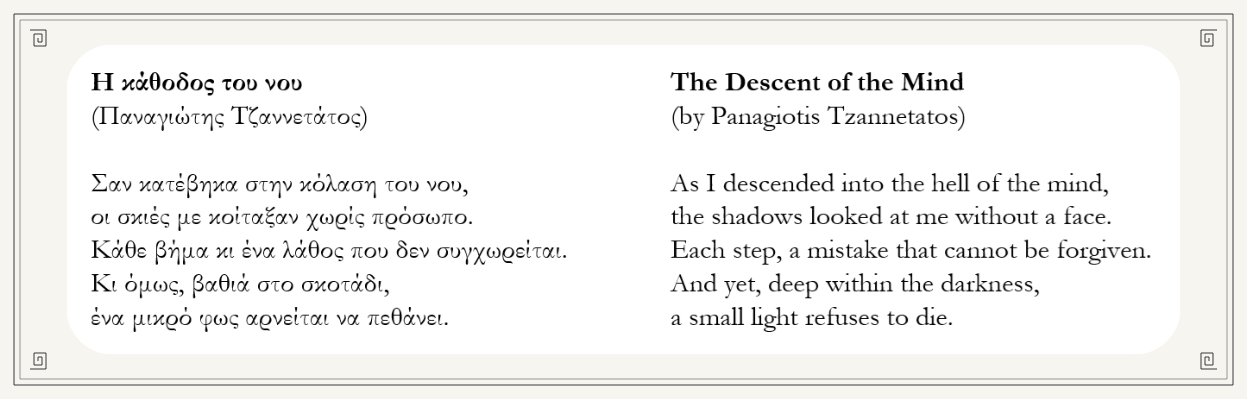
H κάθοδος του νου
(Παναγιώτης Τζαννετάτος)

Σαν κατέβηκα στην κόλαση του νου,
οι σκιές με κοίταξαν χωρίς πρόσωπο.
Κάθε βήμα κι ένα λάθος που δεν συγχωρείται.
Κι όμως, βαθιά στο σκοτάδι,
ένα μικρό φως αρνείται να πεθάνει.

&

The Descent of the Mind
(by Panagiotis Tzannetatos)

As I descended into the hell of the mind,
the shadows looked at me without a face.
Each step, a mistake that cannot be forgiven.
And yet, deep within the darkness,
a small light refuses to die.