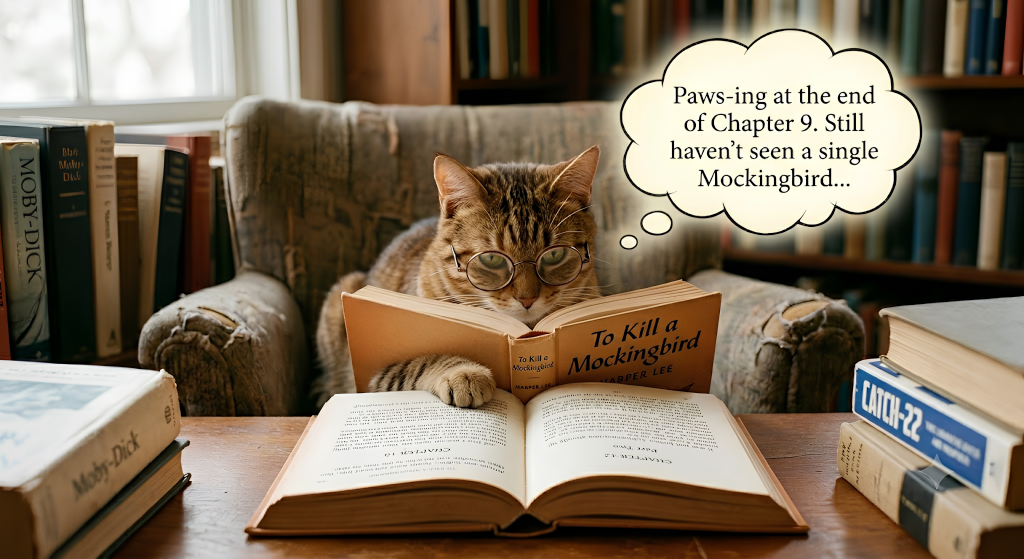
The Aristo-Cat of Letters, Sir Thomas, was no ordinary feline. In his extensive, wood-panelled library, where books stacked in precarious towers rivalled the ones found in the Bodleian Library at the University of Oxford, he pursued a singular passion: literary research on avian subjects. His current focus was, of course, the classic Harper Lee novel.
Our British Shorthair tabby was a serious scholar. Adorned in his round spectacles, paws resting on the pages of his open book, he was a fixture of intellectual rigour. But after finishing Chapter 9, he was frustrated. And so he began to suspect a grand conspiracy by the avian world.
The problem, he deduced, was that his library was too civilised. If he wanted to find a mockingbird, he needed to investigate in the field.
‘They’re mocking me,’ Sir Thomas hissed, a sophisticated, bespectacled hiss. ‘I am the only valid Mockingcat, and these authors write entire novels about mythical birds that are always killed off-page.’
He decided on an experimental approach. He would build a decoy. A “mocking-mockingbird”. He gathered feathers from a dusty duster, glued them to a walnut shell, and placed it on a low branch in the library’s window nook.
Then, he waited.
Within hours, a real Starling alighted near the decoy. Sir Thomas watched from behind his stack of classic books. The bird inspected the decoy. Then, he looked directly at the cat, a glint of genuine amusement in his tiny eye.
Then, he began to sing.
But it wasn’t a normal song. It was a perfect mimicry of Sir Thomas’s own sophisticated, slightly haughty food-can-opener meow.
Sir Thomas stilled entirely at the sound. The audacity!
Then the bird switched, replicating the sound of Sir Thomas’s squeaky leather chair and the distinct, scratching sound of his nails on the table.
It was psychological warfare. The starling was mocking the Mockingcat.
‘Aha!’ Sir Thomas announced, pushing off Moby-Dick and knocking over a stack of novels. ‘The novel is real! I have found the essence!’
He adjusted his spectacles and prepared to write his critical review. The title would be: The Mockingbird: A Case Study in Sonic Mockery and Literary Deception of the Primal Predatory Form.
He would include an annotation about how the bird had the gall to mimic his sophisticated purr. It was an outrage, but a scientifically validated one. Decoying a Mockingcat was a sin, indeed, but one that finally provided results.
The Author’s Note
Sir Thomas was right in his own judgement.
In the original first printed edition (1960, J.B. Lippincott & Co.) of To Kill a Mockingbird, the word ‘mockingbird’ is mentioned for the first time on page 90. It appears during the famous scene where Atticus is giving Jem and Scout their air rifles:
Atticus said to Jem one day, ‘I’d rather you shot at tin cans in the backyard, but I know you’ll go after birds. Shoot all the blue jays you want, if you can hit ’em, but remember it’s a sin to kill a mockingbird.’
If you are reading one of the standard, widely distributed paperback editions, this same passage usually falls somewhere between page 103 and page 119, depending on the specific text layout.